Artificial Intelligence and Actual Effort

You are created in the image of God, and you carry that holy imprint into every task, every decision, every outcome of your existence. You are not a machine in any sense, and a machine can never replicate the image that sets you apart from it.

When we invented the printing press, washing machine, lawnmower, typewriter, telephone, and thousands of other machines to extend and amplify our physical abilities, we freed ourselves for the higher pursuits of human life. A person who no longer needs a full day to hand-wash her clothes can spare the time and spirit to write poetry, to understand her neighbors, to discover the healing properties of plants growing near her home. 

But we had to find a balance. As the physical convenience of life increased, our bodies first gained strength as they were no longer enduring constant hardship. But there came a point where we began to seek physical exercise because our daily life no longer provided it. We needed to escape the inevitable weakness of muscles no longer in use.

The body houses the brain, sustains it, and acts on its behalf. The brain houses our  intelligence,  our memory, and the earthly coverings of our spirit. Without it, we can’t access our consciousness or maintain our freedom. Creativity, resilience, empathy, self awareness, and the uncountable gifts of the divine image come and go through this fantastic, vulnerable portal. 

This is why artificial intelligence is not just another machine. The convenience it offers doesn’t simply ease the body to support the spirit. Yes, it powers search engines, for example,  reducing the time necessary for research and thereby amplifying the information available for study by orders of magnitude. But it also offers to do that studying for you, to remove the burden of analysis, of attentiveness, of fully completed thoughts. 

What replaces those tasks we’re ceding to the machine? What exercises of the mind have we taken up to maintain its strength? What do we gain in exchange for an active mind?

Especially as we age, we only keep the intellectual powers we regularly use. We run the risk of dependence on what began as a pleasant but unnecessary convenience.  We’re inviting ourselves into enslavement to a supposed liberator that is not created in the image of God. 

Life is hard. Earth is not heaven. That divine image within us calls us to comfort and encourage each other. But doesn’t it also call us to treasure the strength we are given, to work on it and increase it, to urge ourselves onward and upward in doing good? Struggle is not our enemy. When we embrace it faithfully, it can become our friend. Effort is a sign and tool of spiritual life. God protect us from the temptation to give it up!

D-Day: A Photograph

Put yourself into this photo. Your feet in wet boots on that heaving deck, your friends already in the water ahead of you, your ears ringing, stomach writhing, heart thudding, your brain slowing and speeding, your well-trained body moving automatically, your life spinning away from you. Terror. Memories. Adrenaline.

Nobody wants to lunge through bloody water, burdened with equipment, trying not to drown, seeking the shifting slices of air not riddled with bullets. Nobody wants to confront the choice of dying pinned down under fire on the beach and dying in the race across the beach to move inland.

It’s hard to run in the water. It’s hard to run on sand. It’s hot and loud and terrible. It looks and sounds and smells like hell. Home is gone forever. Even if you survive, you will never be the same.

When people say that love is an action, not a feeling, think of this. Think of the work done for you, at enormous cost. Think of the simple, painful beauty, the incalculable horror and strength, of your fellow human beings, laying down their lives for one another and for you.

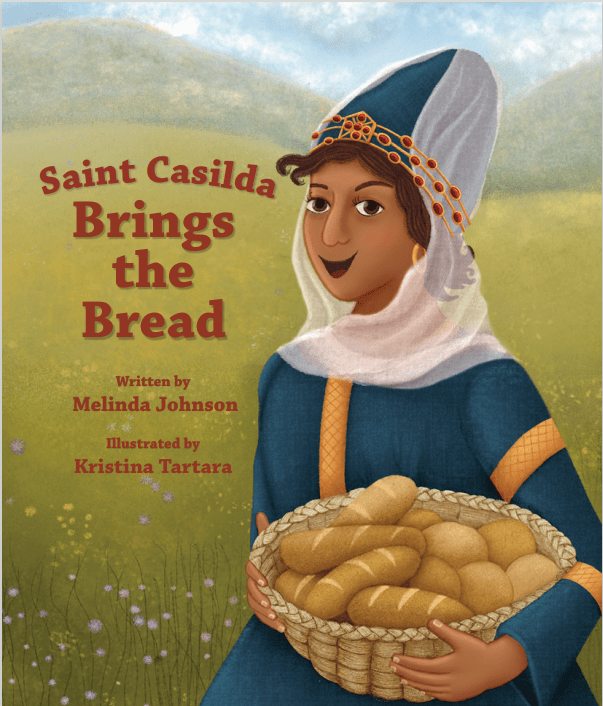
Board Book Story of Saint Casilda of Toledo

Saint Casilda of Toledo was the daughter of the Berber ruler of Toledo in 1oth-century Spain. A faithful Muslim, Casilda still felt compassion for her father’s Christian prisoners and found the courage to visit the prison with bread for them hidden in the folds of her dress. This led her into grave danger, either from her father himself or from his soldiers, according to varying accounts. But in a moment of crisis, Casilda experienced a gorgeous, fragrant miracle that saved her life.

I first encountered Saint Casilda while researching Seven Holy Women. Her story fascinated me, so I included her among the seven, and my friend Melissa Naasko wrote Casilda’s chapter. Melissa felt so befriended by Casilda that she commissioned the only Orthodox icon of Caslida of which we are aware.

Fine art paintings and other western images of Casilda are easily found (see below). Because of the time when she lived (the turn of the first millennium), she is venerated in both Orthodox and Catholic traditions. The Catholics seem to know more about her, possibly because she lived in Spain, and I suspect this accounts for the dearth of iconography.

Saint Casilda of Toledo, by Francisco de Zurbarán – Thyssen-Bornemisza Museum.

Once again, Kristina Tartara illustrated my story for this SVS Press board book. I love working with Kristina! As always, her research brings a wealth of contextual detail to her colorful illustrations.

You’ll see evidence of Kristina’s remarkable patience as well in the illustration of Saint Casilda with her arms full of beautiful, hand-drawn-one-by-one roses. Kristina also kept up her tradition of granting the main character tiny animal friends to accompany her on her adventures. Be sure to look for a friendly mouse or two!

Saint Casilda Brings the Bread is available from SVSPress and on the Ancient Faith Store and Amazon.

Tension around the Table

One of the blessing curses of being a writer is the refined ability to step inside another character’s worldview. You do this so that you can write the character, but the longer I live, the more my brain tries to hop worldviews in real life. To do it well, you must be able to envision motives and emotions for an identity completely separate from your own. But, especially if you’re going to do it in real life, you must complete the exercise without falling into the trap of believing you can actually read another person’s mind.

Although there are genuinely malicious people in the world, I don’t believe they are the majority, or even close to it. Most people, no matter how wrong-headed they appear to their peers, believe there is a valuable or at least necessary reason for their choices. If you are writing this wrong-headed person, or pondering them in real life, you will quickly discover that perception and empathy create confusion.

What’s the first dysfunctional human situation from your own life that springs to mind? (Don’t raise your hand or shout it out. Just think of one.) If you climb out of your own position in the situation and walk around the table, so to speak, it will become harder and harder to decide who is the “good guy” and who is the “bad guy.” It seems to me that the core of our human judgment of other humans rests in whether we think they meant well. Were they trying to do something they thought was good? Were they trying to do harm?

Our cultural paradigm is to solve or explain a situation by identifying a protagonist and an antagonist. We can then support the one and condemn the other with an easy mind.

But the more you seek the details of human psychological and spiritual complexity, the more difficult it becomes to decide who is the antagonist. “There is no one who lives who is without sin.” We are all antagonists. But all creation is lifted up in Christ. We are all protagonists.

This is not an argument for relativism. There are good acts and evil acts, good motives and evil motives. But we have lost our desire or ability, as a culture, to accommodate the presence of spiritual tension in everyone around us, and in ourselves.

Perception, empathy, justice, mercy – all of these open us to unwanted depths of meaning and accountability. We are too tired and frightened to be attracted by the chance to understand and care for each other. And our weariness and fear are strengthened every day by the failure of our peers to understand us and care for us. That is the cycle that wants breaking, in my view.

Photo by Dxaxoxfz on Unsplash

A Small Loveliness

Found on a long-ago Blogger account. This was originally published on November 3, 2014, at 11:13 PM.

Today, I watched my daughter dance. It wasn’t a performance, just a class. I watched the light playing on her skin, watched her bright dark eyes, watched the expressions come and go – the queenly prima, the tired child, the imp, the infant, the wise old woman. She is everything human, dancing.

And above me, in the air, I saw a tiny pink feather, a fragment more graceful than dust but not much larger, flitting and skipping on the warm currents, drifting above me, drifting away, a little memory of tulle and velvet and sweat.

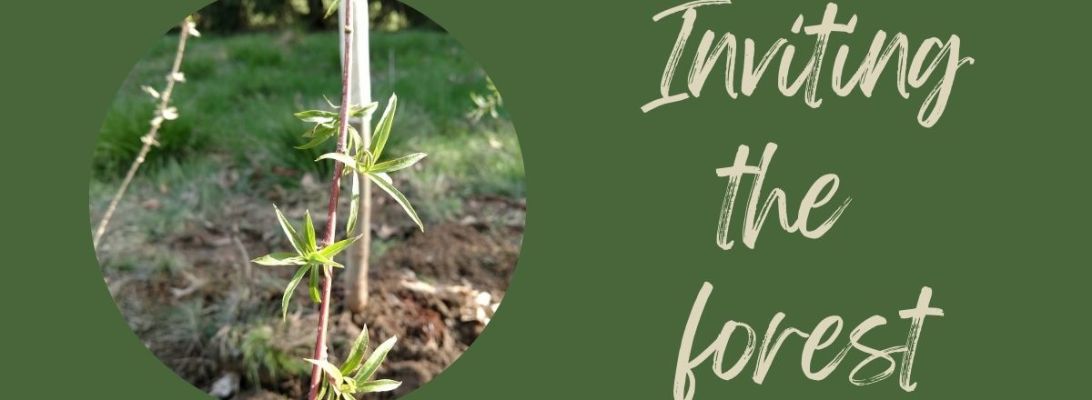
How I Planted a Willow Tree

Our back yard is longer than it is wide. It’s about 1.7 acres, and the lingering woods still cover most of the last .7 acre. If you’re standing on the deck looking at the woods, you notice a bare patch on the left. The woods break, and there’s a swampy stretch of soft earth and weedy hillocks for a few yards before you reach the towering evergreens marking the property line on that side. From its shape, it might once have been the end of a very long drive way. The deer wander through it, passing on to the trees.

During some recent moment of quiet, I remember telling myself it would be nice to plant trees in that bare patch, bringing the woods across to the evergreens. I was eating breakfast, I think. Or staring out a window thinking about saving the planet.

The moment passed. The day continued. The thought vanished.

In a wholly unrelated instance, months before, my mama gave me a tree for my birthday. She doesn’t live nearby, so we researched “trees that deer might not eat,” and she sent me a check, with the understanding that I would buy the tree at a local nursery. Our research and my love of flowering trees led us to select pink dogwood as the object of our desire.

This is not my tree. Photo by Jonathan Hanna on Unsplash

I waited through the end of winter, mentally dropping a pink dogwood in various spots and deciding whether it would do well there. As the spring advanced, I asked the farmer who mows our lawn if he could dig a hole when I had the tree. He said yes and suggested a different spot than the one I’d thought of.

I kept looking and picked another location. The not-yet-present pink dogwood had now been mentally located in three places.

Spring came, sun shone, weather warmed, and I began tree shopping in earnest. The first place had one white dogwood left, no pink. I dithered, but decided to check the other place.

The other place? Had Everything! But no pink dogwood. Apple trees, cherry trees, grape vines, blueberry bushes, oak and maple and holly and too many others to recall. But no pink dogwood.

Voila! The perfect conditions for my brain to run wild! I called my mama, and we debated the merits of starting an apple orchard, or pear, or peach, or planting raspberries in rows (probably near the shed). I skipped from tree to tree, idea to idea, while she asked Google if deer would eat my choice-of-the-moment.

But then, I found a willow tree.

Sneak preview. This is my tree.

Decades ago in an earlier world, we played under a giant weeping willow at my Aunt Greta and Uncle Fred’s house. The wands swept the grass with their finger-tips. We parted them with eager little hands and slipped into a green pavilion, peopled and furnished by make-believe.

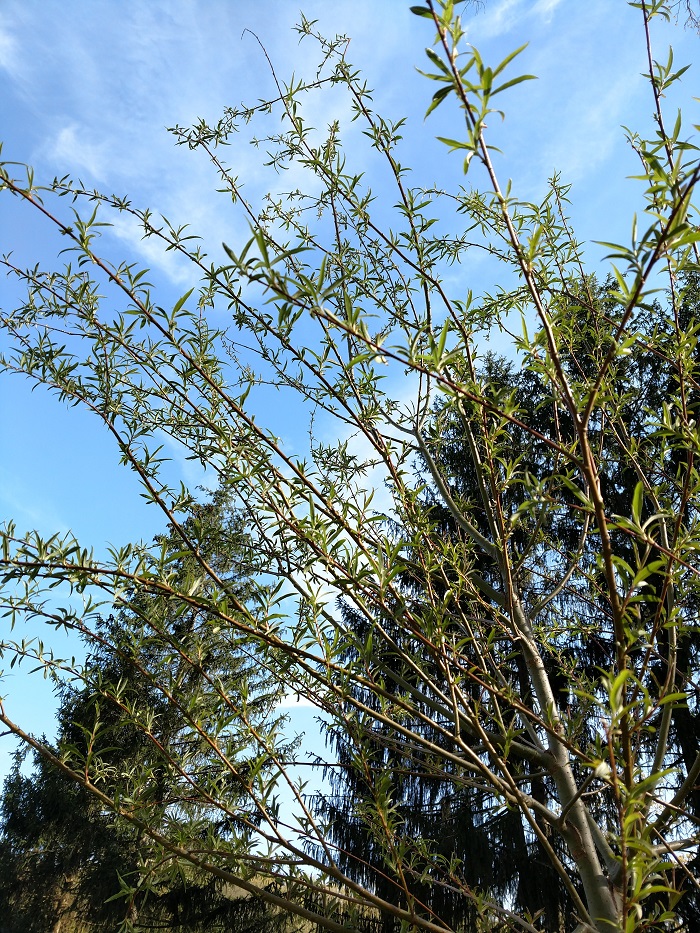
I looked at this present-day willow, nearly ten feet tall, its roots bound in a plastic bucket and its fingers reaching into the blue, and I fell in love.

It didn’t fit in my car. At all.

Leaving my love to the guardianship of a red SOLD tag, I raced home to purloin my neighbor’s truck and his good offices as a tree escort service.

Back again, 10 minutes before closing time, my neighbor and the tree-selling staff person lifted the willow into the back of the pickup and secured it with twine and Boy Scout rope-tying knowledge.

Then we drove home.

Did you know that willow roots can grow up to 100 feet from the base of the tree?

And that they are notorious for entangling and crushing sewer lines?

Not a consummation devoutly to be hoped.

As it turns out, the sewer line runs through the backyard, and the willow, like the dogwood, could not be planted in the spot originally chosen for it.

Evidence of the sewer line’s course across the yard

Taking my daughter, a tape measure, and impervious boots, I paced out 100 feet from the sewer line, bringing myself full circle, into the muddy patch I once considered in my dream of reforestation.

And because it’s such a muddy patch, the earth is soft enough for a distracted writer of children’s books with a good shovel, a sunhat, and some pants she doesn’t care about to dig that hole herself.

So I did.

I wrestled with the earth and muddy gloves and slippery boots. I followed directions and dug a hole twice the width of the potted willow’s footprint.

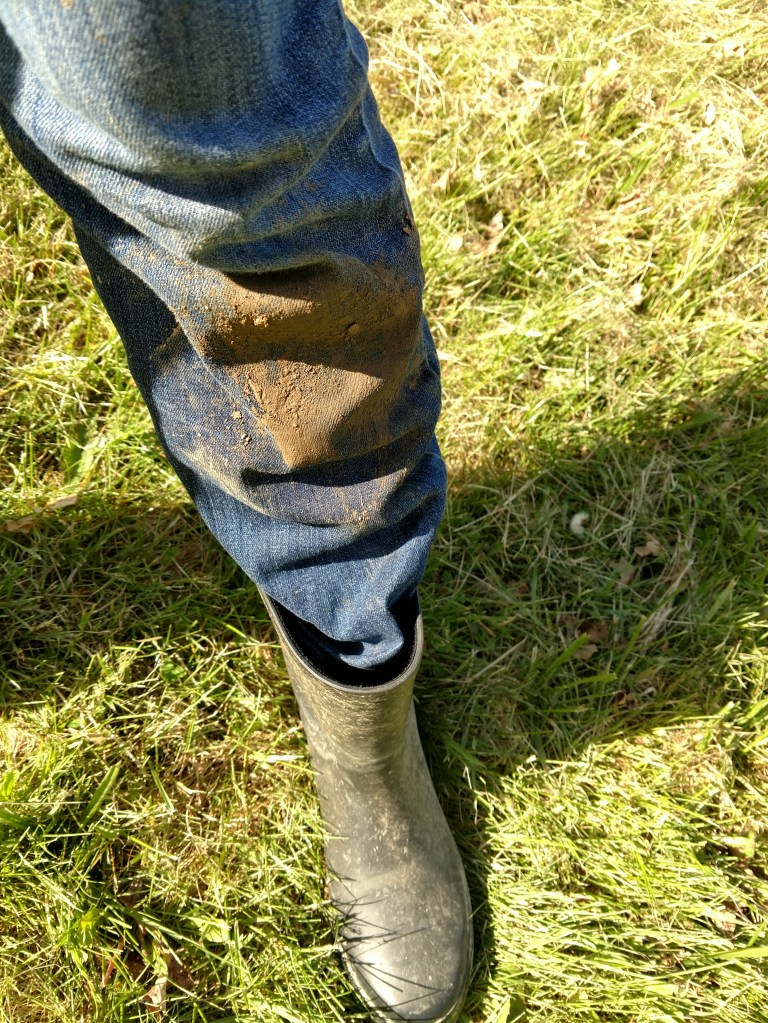
Muddy Blue Jeans taking a selfie with best friend Dirty Boot.

My husband and I hauled the willow across the long yard to the hole and between us, we coaxed it to relinquish its imprisonment. We set its feet in the wet earth, tucked in the roots, and I said a small prayer for it and kissed the tip of a graceful branch.

I dragged out the hose. It’s actually several hoses connected. It’s long, but the yard is longer.

As I was trekking across the space between the end of the hose and the roots of my tree, carrying pitchers of water, I remembered that quiet moment when I’d thought of planting trees here. I saw myself unknowing, pressing along through one decision after another with no recollection or foresight, finding the end of the string where I might have wished to find it, the dream accomplished despite the scattered pathways that led to this good end.

Home, planted, and reaching for the light.

Board Book Story of Saint Eleazar of Anzersk

I’m so happy to announce that Saint Eleazar Fills His Cups is now available for pre-order! Illustrated by my wonderful friend and board-book partner Kristina Tartara, this is the second in what’s becoming a series of saint stories for the littlest believers. Saint Ia Rides a Leaf was our first. We’re excited that these books are finding a home at SVS Press!

Saint Eleazar was a monk who lived in 17th-century Russia. He began monastic life at Solovetsky Monastery, where he was tonsured by igumen Saint Irenarchus. Saint Eleazar was a gifted wood carver, and you can still see his work in the monastery church today.

Solovetsky Monastery stands on its namesake island, which is part of the Solovki archipelago in the White Sea, in northern Russia. But after a time, Saint Eleazar asked the igumen’s blessing to travel to nearby Anzersk Island, to live alone and pray. The igumen granted his blessing, and Eleazar set off.

Anzersk Island in the 17th century was uninhabited, covered in forest, and surrounded by water. There were no towns with shops and no farms to provide food for Eleazar. How would he feed himself? How could he stay alive alone on the island?

Saint Eleazar Fills His Cups is the simple and lovely story of how the saint answered that question. It’s a story about praying to God and using your gifts. In a way, it’s a story about stewardship, a reminder of the miracles we are sometimes blessed to offer one another.

You will love the illustrations. Once again, Kristina has brought the characters and setting lovingly to life, including some animal friends who might have watched Saint Eleazar as he prayed and worked on Anzersk Island. I never get tired of working with her. I love seeing the life and color and depth of my story grow and blossom as she creates the pictures. In children’s books, the pictures are almost more important than the words.

Saint Eleazar Fills His Cups is available for pre-order from SVSPress HERE. It will release this spring, and thereafter will be available from SVSPress, the Ancient Faith Store, and Amazon.

3 Qualities You Need to Be an Author

Many factors will determine whether you ever become the author of a published book. Some are in your control, and some are not. Education, market forces, communication skills, economic stability sufficient to allow for intellectual life – the list of what impacts you is probably endless.

But there are 3 essential qualities I’ve observed in the 12+ years I’ve been involved in publishing. Whatever else may play a role in your success, you probably won’t make it without these three things. And no, TALENT is not one of them.

Sidebar: Talent is fascinating and complicated. Human beings enter the world with unique proclivities and inclinations. Your brain has preferences, and no doubt they partly depend on what it can do easily. Talent can be a necessary prerequisite in some instances, but it’s one that rarely stands alone. Most things aren’t achievable by sheer giftedness.

In my view, success for an author consists in being both published and read. Your book must arrive in the world and proliferate. It must become a known voice in at least one niche of the human experience. If no one reads your published book, it is a tree that fell in the forest and made no sound.

Thus, you must be effective to be successful. Sounds obvious, doesn’t it? But people forget. In the age of drive-by likes and headline scrolling, you can’t measure impact simply by publication. That’s where these 3 essential qualities come in.

Effective writers, who become successful authors, have 3 qualities in common: perception, coachability, and endurance.

Perception

The first decision you make as an author is what you want to say. This initial step must draw on a well-developed perception of your fellow humans. The beginning of any good book, fiction or nonfiction, is an accurate reading of felt needs. You may believe people need to read about a given topic or perspective, but it frankly doesn’t matter what you think. It matters what your prospective readers think. If you want actual communication to occur, you need to grasp THEIR opinion of what they WILL read.

Don’t misunderstand me. I’m not suggesting you go out and pander to the most commercially viable self-interest you can find.

I’m suggesting you put down your ideology, your experience, and your aggravation and place yourself as much as possible in other people’s shoes. Watch and listen without judging. Try to quiet everything but your powers of observation. What hurts them? Why does it hurt? What brings them joy? Why? What do they feel they are missing? Where do they go looking for it?

Let a little time pass. Did you observe a momentary trend, washed away by the next big thing? Or have you seen something real, something you can work with?

At this point, your perception turns inward. It’s essential to apply that same clear-sightedness to yourself. What do you have to offer in response to the needs you have perceived? Can you help? It’s going to take more than good will, and it’s going to take more than talent. What solution to their need can you truly identify and communicate?

Be realistic with yourself. No one author can write every book. Maybe research will make you capable. Maybe it won’t. We can be most fruitful when we play to our strengths. Do you have a strength you can polish and develop to meet their need? Yes? Then get started! No? Let that idea go. Turn your perception outward again. Keep looking for a genuine need that you are uniquely qualified to fill, a meaningful story you are equipped to tell.

Coachability

Congratulations! You applied your perception effectively, found a need, got down to business, and produced a manuscript. You survived the adventure of convincing a publisher to contract your book. The hard part is behind you, right?

Sort of.

A contract is a huge accomplishment! Toast your victory, call your friends, sleep all day Saturday, and revel in your awesomeness.

And then, sit down and buckle up.

Relinquish the rosy dream that what you submitted to the publisher was ready for publication.

It was not.

No, yours wasn’t either.

Or yours.

What you submit to a publisher is your writing pushed absolutely as far as you can push it without their editorial help.

Read that again.

You need an editor. You need the next dimension, the person who won’t mentally fill in what you meant to say, the fabled blue penciler whose professional career thrives on her ability to show you every hole you couldn’t see in your writing and support your dogged efforts to reconstruct that book without those holes.

Do not argue that the holes aren’t there. Do not decide you are a better writer than the editor. Do not get married to that paragraph in the third chapter she says must go.

Do not.

Is the editor always right? No. Is the editor usually right? Yes. Is that the point? Not really.

The editor is a trained linguist and skillful communicator who will bring your good writing to excellence. The editor is also the publisher’s front line. The publisher expects the editorial staff to guide authors to produce books worthy of their platform and appealing to their market. The editor’s pleasure in working with you will strongly impact their interest in your next submission. But more importantly, your open mind and collaborative spirit will drastically improve your writing and the subsequent success of your book.

Endurance

You don’t even need me to write this section, do you? It’s obvious. All the perception and coachability in the world won’t save you if you don’t have endurance.

You need the patience and motivation to stay the course, to keep on observing, writing, rewriting, listening, polishing. You need to keep caring about your topic or story and your readers all the way to the end. You need to fuel your endurance with the love that started you on this journey. Endurance is your commitment to that bright, quixotic, recurring ITCH God created in you that makes you write.

Take a break. Let the writing cool for a bit. Drink tea. Race beetles on the deck rail. Enter a racquetball tournament. Watch the 1966-1967 Russian version of War and Peace. All 7 hours of it.

And then, get back to your writing, to your revision, to the last round of changes your editor wanted. Get back to finishing your book. Be true to the blessed opportunity you’ve been given to say something worth saying, to say it well, and to those who are waiting for something lifegiving shining through your words.

War Is Exhausting

Speaking as a veteran’s wife, one thing people forget about war is how uncomfortable it is. I don’t mean in the obvious ways (bullets, bombs, fire), but the lost amenities that would comfort us on ordinary days.

Today, ask a question about each thing you touch: how would war affect it?

Could you still turn on the lights?

Take a hot shower?

Sleep through the night?

Clean your clothes?

Make tea?

Shop for food?

Go somewhere quiet?

Take a break?

Call a friend?

Check your social accounts?

Log in to your online banking?

Get through your To Do list?

Work and get paid?

Close your door and lock it?

In disaster areas, exhaustion is universal. Of many causes, one is that NOTHING is automatic or simple. Every tiny task becomes an arduous, often unsuccessful quest. Most needs are unmet, and it’s not possible for the average person to solve the problem.

Life, in fact, is out of control.

Control is a civilian, peace-time myth. In war, it is no longer sustainable. So if you still think you have it, give thanks for the lights and the food and your favorite corner of the sofa.

Oh Lord, comfort the comfortless.