#MakersMonday: An Interview with Daniel

Today’s guest on #MakersMonday practices the fascinating and ancient art of wood carving. Daniel designs and creates in his shop, Candelar, in the north of England, and we connected during an artisan’s event sponsored by the Ancient Faith Store. As always, I’m asking 5 questions. Here’s how Daniel responded.

TELL US ABOUT YOUR WORK.WHAT DO YOU CREATE?

I am Daniel Mihailescu, an Orthodox Romanian artisan living in the UK, where, by God’s mercy and providence, I own a small workshop specialised in the design and manufacture of liturgical objects.

HOW DID YOU LEARN TO DO THIS KIND OF WORK?

By trade I am a naval design engineer, and so I was blessed to have the design skills needed for the production of crosses, icons, vigil lamps, and other such wood-carved products.

WHAT DO YOU FIND SATISFYING ABOUT BEING A “MAKER”?

Having the freedom to work from home or in my workshop, in my own time, surrounded by beautiful people, all artisans in wood carving, pottery, music or painting, makes me happy, peaceful, and I love being a ‘maker’.

WHAT’S YOUR FAVORITE MEMORY ASSOCIATED WITH PRACTICING YOUR CRAFT?

My favourite memory is about Father Paul from Australia. On many occasions we add a thank-you item in the order shipment, and I remember thinking that Father Paul would definitely like one of our blessing crosses. As it happened, a few days after shipping the parcel to Australia, Father Paul emailed us saying that he would like to order a blessing cross!

SHARE A PHOTO OF A FAVORITE PIECE, AND TELL US THE STORY THAT GOES WITH IT.

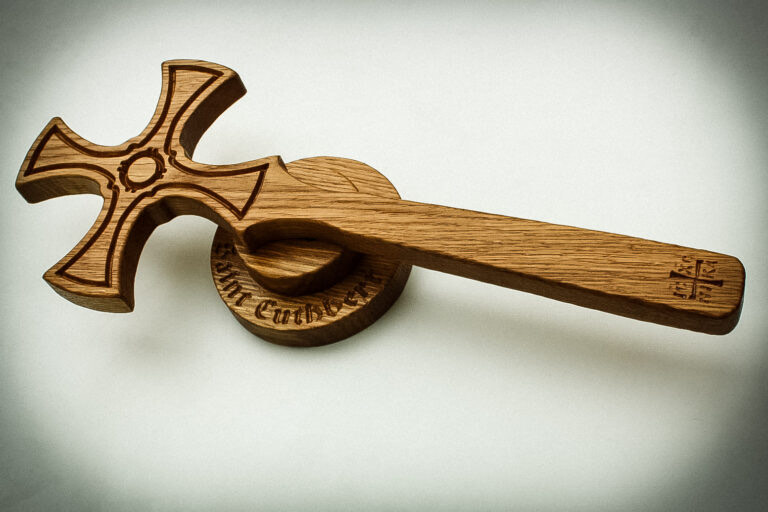
“Have faith and wholeheartedly trust God Who will never abandon those who Love Him”—these words belong to Saint Cuthbert, “the wonderworker of the English land”, who was born in Northumbria around 634.

Saint Cuthbert possessed a rare spirit of endless love of God, of people and of every single creature of God. He had kindness, great compassion and zeal in preaching the Gospel; for his humility and loving heart, the Lord bestowed on Cuthbert the gifts of prayer, miracles, prophecy, and clairvoyance.

Father Justin from the “Orthodox Church of Saint Cuthbert and Saint Bede” in Durham suggested a beautiful oak blessing cross to honour Saint Cuthbert and we are grateful to God for the result.
Thank you, Daniel!

You can connect with Daniel and see his beautiful work at Candelar.co.uk.

#BlogtownTuesday: Interview with On Faith and Life

Today’s interview with Charla at On Faith and Life is extra fun for me because Charla started blogging BECAUSE of #bloginstead! We met in a book review group I administer for work, and now she’s got a great place to publish those reviews. As I do every week, I’m asking 5 questions. Here’s how Charla responds.

How did your Blog Get Its Name?

I started this blog on a whim, and I didn’t want to pigeonhole myself into writing on one specific subject—so I named it in the most general way possible. I’ll be writing a lot about my conversion to Orthodoxy, but I hope to do so in a way that connects with people of all faiths; and I’ll also be writing about life—being a mom, daughter, wife, and beyond.

What would you say is the defining characteristic of your blog?

I’m just starting out as a blogger so I’m not really sure yet where this is going. It’s pretty exciting to have such an uninhibited space in which to write. Basically, I can write about anything I want, any time I want, and I think that’s pretty amazing!

I really like the idea of having a conversational-style blog where I can write and share things that are relevant to my Orthodox Christian faith. I want to be able to connect with others without limiting it too narrowly—for example, I’m a mom and a homemaker, but I don’t want to connect only with other moms and homemakers. I want the conversation to be Deep and Wide {old Southern Baptist hymn reference there!}.

You’re not likely to find deep theological discussion here—I will not be hosting a book club discussion on the Philokalia—but you are likely to find everyday theology, and things such as book reviews, as well as links to articles and resources that have resounded with me. And maybe a recipe here and there. And perhaps some discussion on liturgical living. Stay tuned.

What’s your favorite thing about blogging? Least favorite?

So far I love the actual writing and I love connecting with other bloggers, but I’m already starting to feel the pressure to post on a regular schedule, develop a format, etc. (To be fair, this is internal pressure.) I feel like there is a huge push to market in the blogging world, and that’s just not on my list of priorities right now.

You’re a member of #Blogtown, a social blogging collaborative. How is blogging social for you?

I simply love being able to connect with other bloggers. I’ll be honest—it’s especially wonderful for me to connect with other Orthodox Christians, because sometimes our “world” can seem pretty small. Coming from the Protestant world, where everything these days is very connected and virtual—and there are just so.many.options—it’s nice to be able to build a network of like-minded thinkers, writers, dreamers. But like I mentioned above, I want to be able to connect widely, also—as a convert I think it’s a wonderful challenge to present the Orthodox faith and life in a way that’s accessible to others.

Tell us 3 things we’d know if we’d grown up with you

  1. The first thing I ever drove was a tractor.
  2. When I was 10 years old, I won the blue ribbon at the state fair in the cake decorating category.
  3. I grew up in a 100+ year old Southern Baptist church where my grandparents and great-grandparents were members. Many of my family still attend that church.

Thank you, Charla!

You can connect with Charla at On Faith and Life. See you in #Blogtown!

#MakersMonday: An Interview with Amber

My spirit animal is something that flies around the forest, telling all the other animals good news. It’s one of my favorite things in life – having good news and the opportunity to share it. The #BlogtownTuesday mini-interviews I’m sharing introduce people I connect with in my social blogging experiment. Today, I’m starting a second series, #MakersMonday, introducing creative people making lovely and interesting things. My first guest is Amber, at Streams in the South. I’ll ask my #MakersMonday guests 5 questions. Here’s how Amber responded.

Tell us about your work.What do you create?

I can make all sorts of things, but I have chosen to focus on machine embroidery for Streams in the South. Machine embroidery is a quick way to customize an existing object or make a new one. It enables me to support both Orthodox embroidery designers and folks who sew, which helps the creative community.

How did you learn to do this kind of work?

In 2012 I created a blog called 50 First Crafts. I started the year with woodworking and tried so many different craft techniques. I met local makers and tried things I had never even heard of before. I loved it. I took a class on machine embroidery that year at a local maker space, then a friend gifted me her unused embroidery machine and the rest is history.

What do you find satisfying about being a “maker”?

I love making things. If I could I would make everything that I use on a daily basis. The most satisfying thing about being a maker is knowing that my items are of use to people. I still use some of the things I made for the blog, and I hope they last long into the future.

What’s your favorite memory associated with practicing your craft?

My favorite memory of crafting in general is when I was a child my mom would sit in our big rocking chair and crochet blankets while I learned alongside her. With the embroidery machine it is the time that I brought it to our parish craft fair and let the children choose what designs and colors to embroider on the items I was making for sale. I hope it inspired them to try making some of the things they use in their own homes.

Share a photo of a favorite piece, and tell us the story that goes with it.

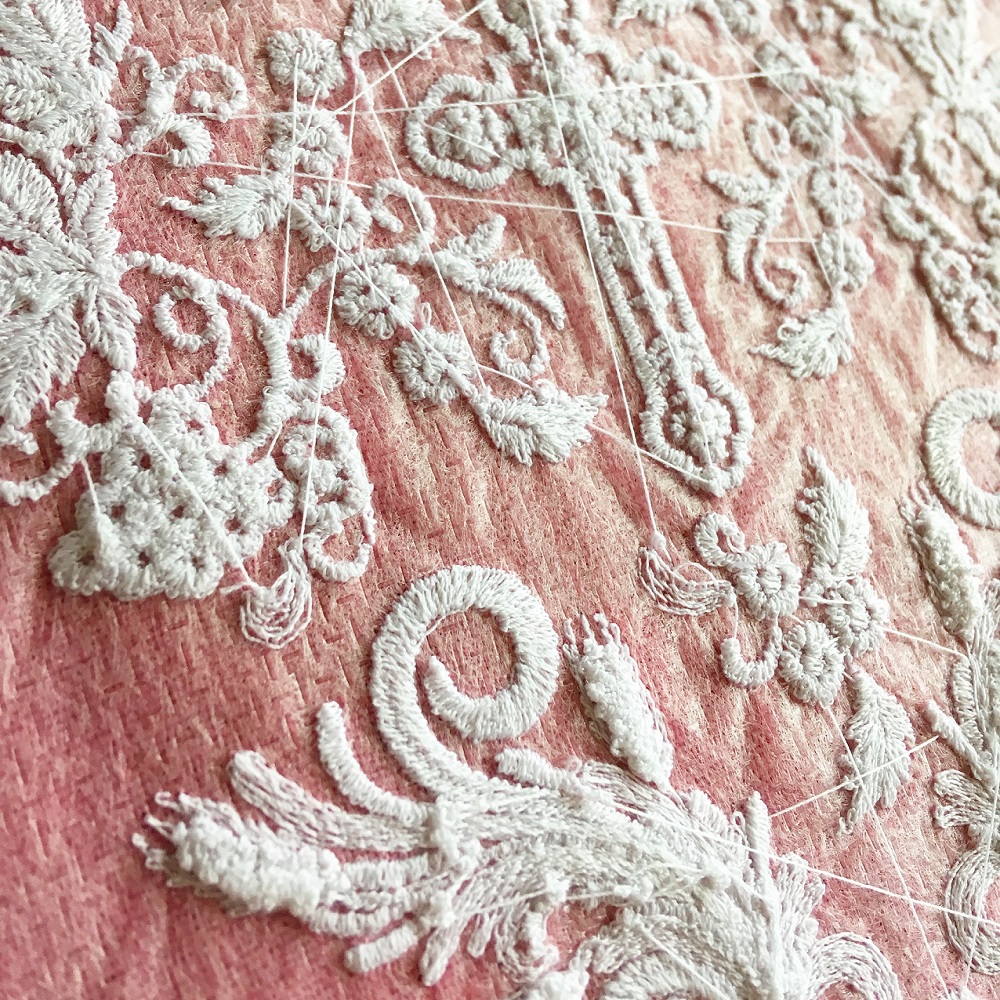
My photo (below) is the back of a Pascha basket cover that I made last year. The linen is from a set of vintage napkins that I found at a thrift store. They are gorgeous and soft. The design is by a Russian woman who has the most beautiful and elegant historical reproduction embroidery designs for sale. I wish I could make everything she releases! The photo shows the back because I was in awe of the detail she put into her design. The back is possibly more beautiful than the front. The whole piece ends up looking and feeling like an heirloom even as I am working on it. I like to imagine it being handed down from a grandmother to her grandchildren and all of the Pascha memories it may one day hold.

Facebook is a stalker boyfriend.

Don’t laugh!

OK, laugh a little. I love laughing!

But this metaphor actually works. Read on. I’ll show you!

The metaphor popped into my head in the car, as I was moseying along between the grocery store and the mall. It sprouted from a conversation with a fellow blogger this week about what kind of reach you get for different kinds of Facebook posts. Reach is strongly effected by post type. You can read about it in many places – here’s Buffer’s take.

To summarize, value on Facebook, as in all social media, is determined by reach, and the type of post you create will directly impact its reach. Live video is the sparkly platinum, top-tier post type on Facebook. Video uploaded directly to Facebook, but not created live on Facebook, is a close second. Posts with images come next, significantly below video, and the lowest form of post, with reach often not discernible to the naked eye, is a post sharing a link to content on another site.

What about text-only posts? (Text only? Is that even a thing anymore?) If I were guessing, they’d fall just above posts sharing a link. Nothing is below a post sharing a link.

Having read the above, you will now easily follow my metaphor. Facebook is a stalker boyfriend.

Stalker boyfriends, also known as the possessive type, creepers, and abusers, love one thing more than any other. They love control. They don’t want you talking to anyone else. They don’t want you spending time with anyone else. They don’t want you thinking or feeling anything outside their control.

Yikes. Yikes!

So what does stalker Facebook like best? Facebook live! That’s right! It’s created on Facebook, by Facebook, for Facebook. It’s you devoting your whole attention to Facebook. Stalker algorithm will reward that behavior all. day. long.

Video posts that aren’t live, and picture posts, are the next best thing. Not really best….I mean, if you can’t do live video, an image post will do. True, it wasn’t created BY Facebook, but it is posted on Facebook, and nobody can see it without Facebook. You neeeeed Facebook for these posts. Facebook will half-heartedly ensure those posts get a response, so you’ll keep making more of them. On Facebook. For Facebook. So that maybe you’ll get excited. And make a video.

What about that lowest form of post? A post sharing a link? You can probably guess what’s wrong with that. A link post is designed to take the reader AWAY FROM FACEBOOK!

No.

We obviously can’t have that.

So, stalker Facebook will prove to you that you should have stayed with stalker Facebook. Go ahead and post your link post. No one will see it. Facebook will make sure of that. You’ll have to stay with Facebook. You should make a meme, or post a video. Your reach will go back up. Seriously. It will be better this time. Just come back. Maybe you’d like to make a live video?

Yikes.

Shall I compare thee to a summer’s day?

In seventh grade, my English teacher required the class to memorize Shakespeare’s Sonnet 18.

Decades later, I still remember it.

What makes certain words last forever in my mind? Why do others, apparently more important, vanish minutes after they arrive?

When someone you love experiences Alzheimer’s disease, you ponder memory as you watch it disappear. It’s like an onion, many layered, and one by one the layers peel away. The first layers are at the core, and they last the longest. Our oldest memories, made when our brains and lives were fresh, remain with us when later life has disintegrated.

There are medical reasons for this, and I have read about them, a little. But I am not a scientist. I am a writer, always looking for the poetry of things. Everything is symbol, and symbol glimpses truth. I think we gaze into the heart of things in these glimpses. We can’t take in the entirety, so we must content ourselves with musing and pattern-seeking, waiting for the eventual gleam of light or the bright burst of insight.

Sonnet 18 remains with me because my brain was young when I encountered it. But that can’t be the only reason. What else did I learn in school that year? Ten months of curriculum framed that sonnet, and much of it is lost to me, or blurred, and if I remember it at all, I do so only when present-day context reminds me that I once knew something about it.

Love strengthens memory, I think. I love beauty. Real beauty. Deep, bright, lasting, shining things. I love words. I love them so much. I was seeking after beauty, even in seventh grade, and Sonnet 18 is beautiful. Lyrical, spiritual. Layered.

A friend of my sister’s sketched her in profile that year, or the year after. It was a good sketch. Her friend was talented. Finishing the sketch, across the top she wrote, “Shall I compare thee to a summer’s day?” in light, graceful script.

Someone (it may have been me) in the class began work on a parody of the sonnet. “Shall I compare thee to an Oldsmobile? Thou art more shiny, and more round of wheel.” I’m not sure this effort went any further. Fortunately.

Memory is part of the sonnet’s beauty now. I am not young now, and I am not old. I’m journeying through the years between those places, and I have shaken off much of the chaff in my inner world. I know what’s precious to me, then and now and some day, and I like to take it out and polish it. I like to say the words and hear them again, with their old associations and current perceptions.

I can still say this sonnet from memory. I will type it for you here.

Sonnet 18

Shall I compare thee to a summer’s day?

Thou art more lovely and more temperate.

Rough winds do shake the darling buds of May,

and summer’s lease hath all too short a date.

Sometimes too hot the eye of heaven shines,

and often is his gold complexion dimmed.

And every fair from fair sometimes declines,

By chance or Nature’s changing course untrimmed.

But thy eternal summer shall not fade,

nor lose possession of that fair thou ownest.

Nor shall Death brag thou wanderest in his shade

when in eternal lines to time thou growest.

So long as men can breathe and eyes can see,

So long lives this, and this gives life to thee.

Now I’ll look it up and measure my memory against the original. Here it is.

Sonnet 18 in the 1609 Quarto of Shakespeare’s Sonnets
By William Shakespearehttp://luna.folger.edu/luna/servlet/s/by2g21, CC BY-SA 4.0, Link

It’s still mine. Punctuation and capital letters have faded here and there, but the Sonnet remains with me, as it promises to do.

#BlogtownTuesday: Interview with Metanoia Bum

It’s #BlogtownTuesday – time to meet another member of our community. Today we’re visiting Nic at Thoughts of a Metanoia Bum. As I do each week, I’m asking 5 questions. Here’s how he answers!

How did your blog gets its name?

In college, one of my favorite books was Jack Kerouac’s The Dharma Bums, which was largely about Kerouac and his friend, poet Gary Snyder, wandering in the mountains and exploring Buddhism, amongst other things. I loved the book for a long time, but when I became Orthodox, I joked that the Orthodox version would be a “metanoia bum”- metanoia being the Greek word for “change of heart.” I’ve used the phrase ever since as a social media username, and it seemed appropriate when I started this blog in 2017. 

What would you say is the defining characteristic of your blog?

I would say that a characteristic feature of my blog is that it contains a strong sense of observational wonder about the world around me. Things often happen out of nowhere, and I write about them to highlight the glory and joy of how we are truly connected as children of God.  I’d also say that a willingness to be open about struggle, emotions and conflicts – largely with myself! – is also a standard part of the experience. The blogs are for the world around me, but also, in some cases, essays to myself. 

What’s your favorite thing about blogging? Least favorite?

I love two things: (1) being able to help people through sharing my own experiences; and (2) the challenge of trying to say something really meaningful within a short format; it has challenged me to think about how I communicate ideas to the world. The thing I dislike is when I have an idea, and it gets stuck. Not being able to get it onto paper, and then often realizing that it may not be ready for the world, is hard. But it’s also helpful.

You’re a member of Blogtown, a social blogging collaborative. How is blogging social for you?

I have built a really strong community because of blogging, not only virtual, but also in-person. Things I have written become centers of conversation in my own home community, and virtual connections have become in-person physical friendships that are real and tangible. It’s fun to see who likes things, who comments, who shares, and how those shares reach other people outside of my own world. My most-read piece, “Guys, You Don’t Have to Be a Priest,” made it outside of the Orthodox world, and was read by Catholic, Anglican, and many other denominations. That impact allows me to feel connected to the bigger world. 

Tell us 3 things we’d know about you if we’d grown up with you.

My notebooks are full of cars, imaginary cities, and maps. That is still the case.

I started college with the idea of being a physician or a physical therapist. 

I was a tech theatre and classics geek in high school, and once got a 1st place award nationwide for one of my projects!

Thank you, Nic!

You can connect with Nic at Thoughts of a Metanoia Bum. See you in #Blogtown!

Bloginstead

Who Has Known Heights

This poem has lingered in the reaches of my consciousness for decades. I don’t recall where I first read it, only that I shared it with my Dad, who understood the feeling it conveyed.

Who Has Known Heights

Who has known heights and depths shall not again
Know peace – not as the calm heart knows
Low, ivied walls; a garden close;
An though he tread the humble ways of men
He shall not speak the common tongue again.

Who has known heights shall bear forevermore
An incommunicable thing
That hurts his heart, as if a wing
Beat at the portal, challenging;
And yet – lured by the gleam his vision wore –
Who once has trodden stars seeks peace no more.

Mary Brent Whiteside

I remember how strongly I felt, reading this poem, how well it expressed my experience then. But now that I’ve found it and read it again, after these decades of life have washed over me, I can see that it is no longer all of my experience.

I do seek peace now.

The heights and depths are there, but they exist more in my inward thoughts. I have learned to guard them, and I have learned that sometimes weariness trumps artistic exuberance.

The memory of those heights tinges my quest for peace with guilt sometimes, and I believe that’s good. I don’t want to be a seeker of peace at any price. I want only to maintain the balance I hadn’t yet discovered in those urgent younger days.

Whether I will or no, I exist within limits. I reread books I’ve read dozens of times. I decide not to watch a film I know will make me cry. I accept the spiritual poetry of scrubbing dirty dishes in warm water in a home of my own.

I choose my quests more cautiously, remembering that final victory may elude me or, more likely, appear in ways and times that can’t be prophesied.

Board Book Contract with SVS Press

I am SO happy to announce that in company with talented illustrator Kristina Tartara, I have signed a board book contract with St. Vladimir’s Seminary Press! God willing, the book will release the Fall of this year.

Now that I’m blogging again, I’m going to enjoy musing and reveling my way through the publication process. I adore books with pictures, and I will never, ever get tired of the magic of writing a book and seeing it illustrated. It is one of the world’s great enchantments, for me. Kristina has already sent me a few tiny sketches – just lines, already full of character and humanity. It is WONDERFUL.

Board books are like word puzzles, I find. You have a story, and it may be quite large. The setting includes oceans and mountains and multiple human beings, and there are sounds and feelings and layers of meaning, and all of this? All of this. All of this must be poured into 300 words. 300 tiny words. So first, I write the story, wandering around it in my head, letting it be the words it can first lay hold on, and then I go back and shave off words. Polish. Polish. Polish. Words fall off like wood shavings, and the story grows clearer as it grows smaller. At last, it fits into those 300 chosen words, and I am satisfied.

Sometimes, the story happens in 20 minutes. Sometimes it steeps in a misty corner of my mind for months before it arrives.

And now, with 300 words and the clear visions of the inward eye, I let go of it and Kristina’s inward eye and skillful hand bring it to even greater life.

I love this.

I’ll be sharing the story behind the story, the main character, the history, the setting, the illustration process, and all the fun we have after it gets published. But for now, I will leave you with a hint.

Here is a picture of the location where the story is set. Can you guess where this is? Have you been there? Of course, you have to imagine away the houses. They were not there at the time…

#BlogtownTuesday: Interview with Anna at The Brown Dress Project

In today’s edition of this #Blogtown tradition, we’ll be visiting with Anna at The Brown Dress Project. Anna is someone I know in real life, in part because she’s one of the co-authors of my story-telling devotional, Seven Holy Women, coming out this fall. As always on #BlogtownTuesday, I’m asking 5 questions. Here’s what Anna says!

How did your blog get its name?

The Brown Dress Project came from the life and work of St. Marcella of Rome (325-410). During her widowhood, she drew together other Christian widows and unmarried women into a collective who focused on living simply despite their wealth. They adopted a sort of proto-habit of plain brown linen or woolen gowns to mark their ascetic choices. I adopted the title to show that living one’s faith as a woman in any era is attainable.

What would you say is the defining characteristic of your blog?

The overall goal for my blog is to bring the stories of women saints into the broader conversation of the Orthodox Church. I want to help women identify with the broad expressions of our lived faith. Wherever a woman finds herself, at whatever age or station, there are saints who have walked that path before her. As a historian, I am fascinated with how the Church remembers the saints in a unique story-telling pattern called hagiography. How we tell the lives of the saints is as important as what we say about them. 

What’s your favorite thing about blogging? Least favorite?

My favorite aspect of blogging is being able to work out ideas in writing and finding connections between past and present. My least favorite thing is the writer’s perennial struggle to translate the ideas into text.

You’re a member of Blogtown, a social blogging collaborative. How is blogging social for you?

I thrive on feedback for my writing. It is like beacons along a rocky coast, pointing me to the good harbor of truth. I also enjoy hearing requests for specific saints’ stories or a thank you for highlighting an obscure saint. I have met and made more Orthodox friends that way through word of mouth than through regular social media.

Tell us 3 things we’d know about you if we’d grown up with you.

The Chronicles of Narnia were my bedtime stories with Dad from age 6 until 9. Mom read the Anne of Green Gables series to me in the morning before school. Thanks to my parents, I am a confirmed Anglophile and ruined for common literature. 

I began collecting hobbies from a young age. I was fascinated with baking, sewing, knitting, spinning yarn, growing gardens, etc. Not your average childhood in the Midwestern suburbs! I begged Dad to get a goat or chickens. He did build square foot garden boxes as a compromise. 

Ballet and dance in general were my main after school activities up through high school. I still love to dance, though more sedately, in historical English Country style, like Elizabeth Bennet and Mr. Darcy. 

Thank you, Anna!

You can connect with Anna at The Brown Dress Project. See you in #Blogtown!