Artificial Intelligence and Actual Effort

You are created in the image of God, and you carry that holy imprint into every task, every decision, every outcome of your existence. You are not a machine in any sense, and a machine can never replicate the image that sets you apart from it.

When we invented the printing press, washing machine, lawnmower, typewriter, telephone, and thousands of other machines to extend and amplify our physical abilities, we freed ourselves for the higher pursuits of human life. A person who no longer needs a full day to hand-wash her clothes can spare the time and spirit to write poetry, to understand her neighbors, to discover the healing properties of plants growing near her home. 

But we had to find a balance. As the physical convenience of life increased, our bodies first gained strength as they were no longer enduring constant hardship. But there came a point where we began to seek physical exercise because our daily life no longer provided it. We needed to escape the inevitable weakness of muscles no longer in use.

The body houses the brain, sustains it, and acts on its behalf. The brain houses our  intelligence,  our memory, and the earthly coverings of our spirit. Without it, we can’t access our consciousness or maintain our freedom. Creativity, resilience, empathy, self awareness, and the uncountable gifts of the divine image come and go through this fantastic, vulnerable portal. 

This is why artificial intelligence is not just another machine. The convenience it offers doesn’t simply ease the body to support the spirit. Yes, it powers search engines, for example,  reducing the time necessary for research and thereby amplifying the information available for study by orders of magnitude. But it also offers to do that studying for you, to remove the burden of analysis, of attentiveness, of fully completed thoughts. 

What replaces those tasks we’re ceding to the machine? What exercises of the mind have we taken up to maintain its strength? What do we gain in exchange for an active mind?

Especially as we age, we only keep the intellectual powers we regularly use. We run the risk of dependence on what began as a pleasant but unnecessary convenience.  We’re inviting ourselves into enslavement to a supposed liberator that is not created in the image of God. 

Life is hard. Earth is not heaven. That divine image within us calls us to comfort and encourage each other. But doesn’t it also call us to treasure the strength we are given, to work on it and increase it, to urge ourselves onward and upward in doing good? Struggle is not our enemy. When we embrace it faithfully, it can become our friend. Effort is a sign and tool of spiritual life. God protect us from the temptation to give it up!

D-Day: A Photograph

Put yourself into this photo. Your feet in wet boots on that heaving deck, your friends already in the water ahead of you, your ears ringing, stomach writhing, heart thudding, your brain slowing and speeding, your well-trained body moving automatically, your life spinning away from you. Terror. Memories. Adrenaline.

Nobody wants to lunge through bloody water, burdened with equipment, trying not to drown, seeking the shifting slices of air not riddled with bullets. Nobody wants to confront the choice of dying pinned down under fire on the beach and dying in the race across the beach to move inland.

It’s hard to run in the water. It’s hard to run on sand. It’s hot and loud and terrible. It looks and sounds and smells like hell. Home is gone forever. Even if you survive, you will never be the same.

When people say that love is an action, not a feeling, think of this. Think of the work done for you, at enormous cost. Think of the simple, painful beauty, the incalculable horror and strength, of your fellow human beings, laying down their lives for one another and for you.

Tension around the Table

One of the blessing curses of being a writer is the refined ability to step inside another character’s worldview. You do this so that you can write the character, but the longer I live, the more my brain tries to hop worldviews in real life. To do it well, you must be able to envision motives and emotions for an identity completely separate from your own. But, especially if you’re going to do it in real life, you must complete the exercise without falling into the trap of believing you can actually read another person’s mind.

Although there are genuinely malicious people in the world, I don’t believe they are the majority, or even close to it. Most people, no matter how wrong-headed they appear to their peers, believe there is a valuable or at least necessary reason for their choices. If you are writing this wrong-headed person, or pondering them in real life, you will quickly discover that perception and empathy create confusion.

What’s the first dysfunctional human situation from your own life that springs to mind? (Don’t raise your hand or shout it out. Just think of one.) If you climb out of your own position in the situation and walk around the table, so to speak, it will become harder and harder to decide who is the “good guy” and who is the “bad guy.” It seems to me that the core of our human judgment of other humans rests in whether we think they meant well. Were they trying to do something they thought was good? Were they trying to do harm?

Our cultural paradigm is to solve or explain a situation by identifying a protagonist and an antagonist. We can then support the one and condemn the other with an easy mind.

But the more you seek the details of human psychological and spiritual complexity, the more difficult it becomes to decide who is the antagonist. “There is no one who lives who is without sin.” We are all antagonists. But all creation is lifted up in Christ. We are all protagonists.

This is not an argument for relativism. There are good acts and evil acts, good motives and evil motives. But we have lost our desire or ability, as a culture, to accommodate the presence of spiritual tension in everyone around us, and in ourselves.

Perception, empathy, justice, mercy – all of these open us to unwanted depths of meaning and accountability. We are too tired and frightened to be attracted by the chance to understand and care for each other. And our weariness and fear are strengthened every day by the failure of our peers to understand us and care for us. That is the cycle that wants breaking, in my view.

Photo by Dxaxoxfz on Unsplash

A Small Loveliness

Found on a long-ago Blogger account. This was originally published on November 3, 2014, at 11:13 PM.

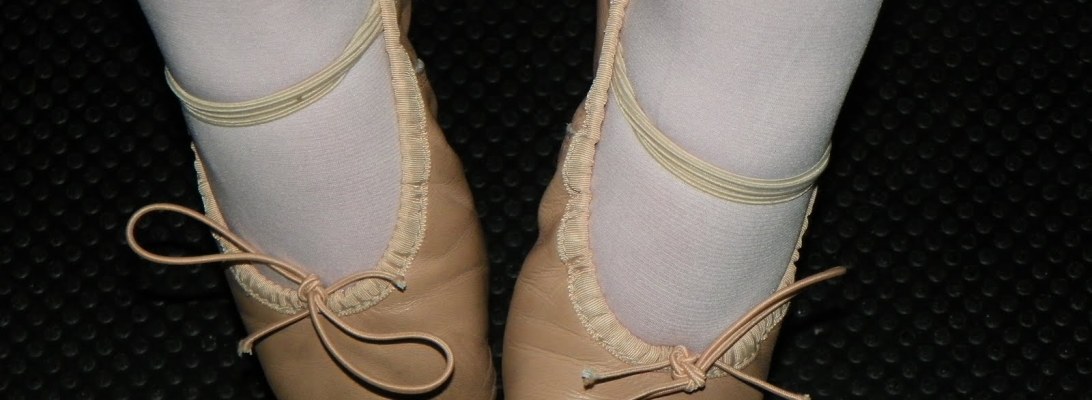
Today, I watched my daughter dance. It wasn’t a performance, just a class. I watched the light playing on her skin, watched her bright dark eyes, watched the expressions come and go – the queenly prima, the tired child, the imp, the infant, the wise old woman. She is everything human, dancing.

And above me, in the air, I saw a tiny pink feather, a fragment more graceful than dust but not much larger, flitting and skipping on the warm currents, drifting above me, drifting away, a little memory of tulle and velvet and sweat.

How I Planted a Willow Tree

Our back yard is longer than it is wide. It’s about 1.7 acres, and the lingering woods still cover most of the last .7 acre. If you’re standing on the deck looking at the woods, you notice a bare patch on the left. The woods break, and there’s a swampy stretch of soft earth and weedy hillocks for a few yards before you reach the towering evergreens marking the property line on that side. From its shape, it might once have been the end of a very long drive way. The deer wander through it, passing on to the trees.

During some recent moment of quiet, I remember telling myself it would be nice to plant trees in that bare patch, bringing the woods across to the evergreens. I was eating breakfast, I think. Or staring out a window thinking about saving the planet.

The moment passed. The day continued. The thought vanished.

In a wholly unrelated instance, months before, my mama gave me a tree for my birthday. She doesn’t live nearby, so we researched “trees that deer might not eat,” and she sent me a check, with the understanding that I would buy the tree at a local nursery. Our research and my love of flowering trees led us to select pink dogwood as the object of our desire.

This is not my tree. Photo by Jonathan Hanna on Unsplash

I waited through the end of winter, mentally dropping a pink dogwood in various spots and deciding whether it would do well there. As the spring advanced, I asked the farmer who mows our lawn if he could dig a hole when I had the tree. He said yes and suggested a different spot than the one I’d thought of.

I kept looking and picked another location. The not-yet-present pink dogwood had now been mentally located in three places.

Spring came, sun shone, weather warmed, and I began tree shopping in earnest. The first place had one white dogwood left, no pink. I dithered, but decided to check the other place.

The other place? Had Everything! But no pink dogwood. Apple trees, cherry trees, grape vines, blueberry bushes, oak and maple and holly and too many others to recall. But no pink dogwood.

Voila! The perfect conditions for my brain to run wild! I called my mama, and we debated the merits of starting an apple orchard, or pear, or peach, or planting raspberries in rows (probably near the shed). I skipped from tree to tree, idea to idea, while she asked Google if deer would eat my choice-of-the-moment.

But then, I found a willow tree.

Sneak preview. This is my tree.

Decades ago in an earlier world, we played under a giant weeping willow at my Aunt Greta and Uncle Fred’s house. The wands swept the grass with their finger-tips. We parted them with eager little hands and slipped into a green pavilion, peopled and furnished by make-believe.

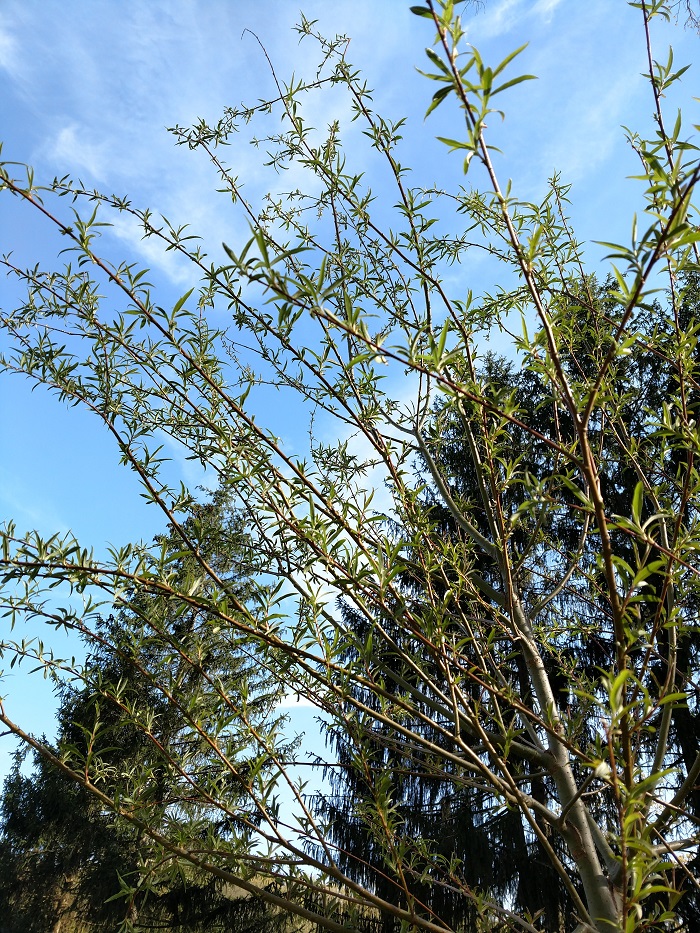
I looked at this present-day willow, nearly ten feet tall, its roots bound in a plastic bucket and its fingers reaching into the blue, and I fell in love.

It didn’t fit in my car. At all.

Leaving my love to the guardianship of a red SOLD tag, I raced home to purloin my neighbor’s truck and his good offices as a tree escort service.

Back again, 10 minutes before closing time, my neighbor and the tree-selling staff person lifted the willow into the back of the pickup and secured it with twine and Boy Scout rope-tying knowledge.

Then we drove home.

Did you know that willow roots can grow up to 100 feet from the base of the tree?

And that they are notorious for entangling and crushing sewer lines?

Not a consummation devoutly to be hoped.

As it turns out, the sewer line runs through the backyard, and the willow, like the dogwood, could not be planted in the spot originally chosen for it.

Evidence of the sewer line’s course across the yard

Taking my daughter, a tape measure, and impervious boots, I paced out 100 feet from the sewer line, bringing myself full circle, into the muddy patch I once considered in my dream of reforestation.

And because it’s such a muddy patch, the earth is soft enough for a distracted writer of children’s books with a good shovel, a sunhat, and some pants she doesn’t care about to dig that hole herself.

So I did.

I wrestled with the earth and muddy gloves and slippery boots. I followed directions and dug a hole twice the width of the potted willow’s footprint.

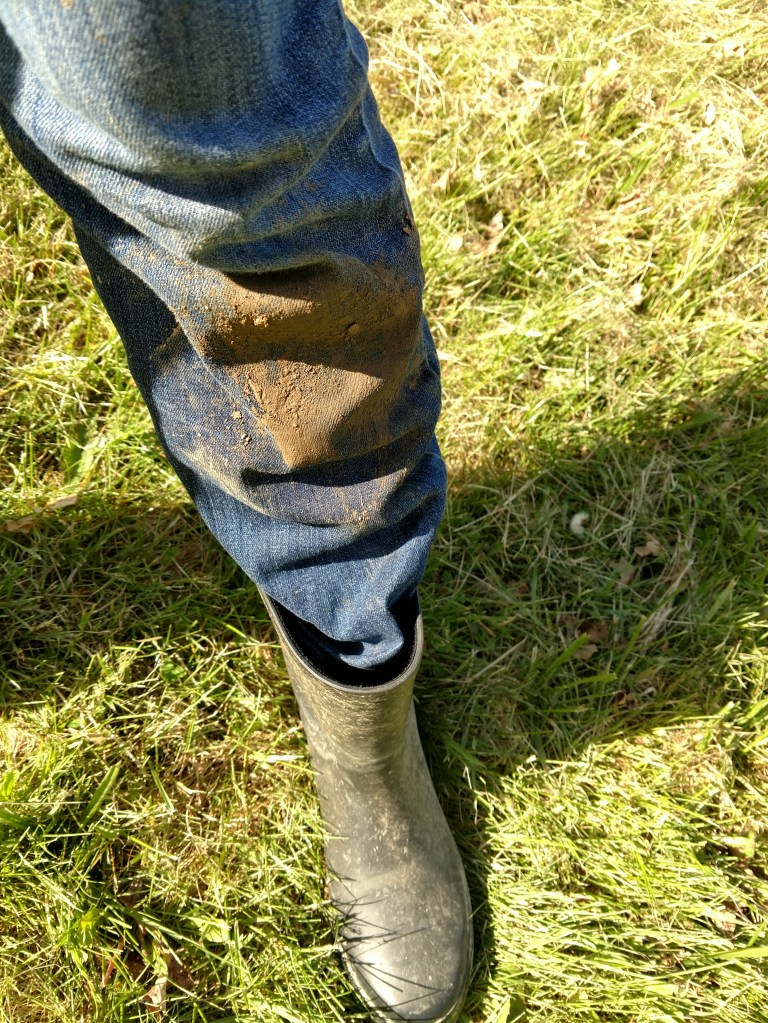
Muddy Blue Jeans taking a selfie with best friend Dirty Boot.

My husband and I hauled the willow across the long yard to the hole and between us, we coaxed it to relinquish its imprisonment. We set its feet in the wet earth, tucked in the roots, and I said a small prayer for it and kissed the tip of a graceful branch.

I dragged out the hose. It’s actually several hoses connected. It’s long, but the yard is longer.

As I was trekking across the space between the end of the hose and the roots of my tree, carrying pitchers of water, I remembered that quiet moment when I’d thought of planting trees here. I saw myself unknowing, pressing along through one decision after another with no recollection or foresight, finding the end of the string where I might have wished to find it, the dream accomplished despite the scattered pathways that led to this good end.

Home, planted, and reaching for the light.

War Is Exhausting

Speaking as a veteran’s wife, one thing people forget about war is how uncomfortable it is. I don’t mean in the obvious ways (bullets, bombs, fire), but the lost amenities that would comfort us on ordinary days.

Today, ask a question about each thing you touch: how would war affect it?

Could you still turn on the lights?

Take a hot shower?

Sleep through the night?

Clean your clothes?

Make tea?

Shop for food?

Go somewhere quiet?

Take a break?

Call a friend?

Check your social accounts?

Log in to your online banking?

Get through your To Do list?

Work and get paid?

Close your door and lock it?

In disaster areas, exhaustion is universal. Of many causes, one is that NOTHING is automatic or simple. Every tiny task becomes an arduous, often unsuccessful quest. Most needs are unmet, and it’s not possible for the average person to solve the problem.

Life, in fact, is out of control.

Control is a civilian, peace-time myth. In war, it is no longer sustainable. So if you still think you have it, give thanks for the lights and the food and your favorite corner of the sofa.

Oh Lord, comfort the comfortless.

Without Your Consent

Can we stop saying “Nobody can make you feel inferior without your consent”?

That’s not empowering. That’s pain-shaming.

It’s also a load of baloney. Sticks and stones may break your bones, but words can break your heart.

Yes, we choose our response to injury, just as we choose our response to affirmation, boredom, opportunity, regret, and all the other facets of human experience. But when we state that a person who feels hurt is consenting to their own injury, we are enabling the one doing harm, not freeing the injured. The perpetrator can now be as hurtful as they desire to be because the pain is your fault, not theirs.

Hurtful words hurt. Hurtful behavior hurts. The pain they cause is real, and it is CAUSED. It comes from the sender, not the receiver.

So let’s stop skipping that part. Before we accept responsibility for our response, let’s assign responsibility to the person and context that made it necessary.

Unhappy Holidays

For what it’s worth:

HOLIDAYS ARE HARD.

We soak up a lifetime of unconscious hopes and assumptions about love, family, success, happiness – and those assumptions crash headlong into reality in moments when we expect to be celebrating.

You are a real person, and if you are reading this, you are not in heaven yet. Neither are the people you know and love, or the people you are related to and can’t stand. Neither are the people posting pictures of the life you wish you had.

Earth is the struggle place. If you are struggling, good job! That’s what we’re here for. You are not a loveless ugly failure. You are a human being, created in the image of God, doing the work He is granting you on your journey to grace and joy.

On earth, we catch glimpses. Minutes, or even seconds of light and relief.

Keep your eyes open for the brightness that finds its way through the cracks around you. Rest in that love for the moments when you can see it. Then pick up your tools and get back to work.

No matter what they tell you, no matter what they show you, the people around you are also struggling and waiting.

List of Orthodox Christian Children’s Books

I was thinking of writing an article encouraging homeschool teachers to include at least one Orthodox children’s book in regular language arts curriculum each year. This led to the idea of making a list of children’s books by grade level. And that led to my best effort at compiling a master list of Orthodox Christian children’s books written in English and currently in print.

No doubt I’ve missed some. The world is a big place, and so is the internet. It wouldn’t be hard for a little Orthodox book, or even a little publisher, to escape my notice.

This list will need constant updating if it is to become a lasting and useable resource. But it is at least a beginning.

CLICK TO SEE THE LIST.

The list is housed in a Google spreadsheet. At this writing, there are 182 entries, and I am aware of at least 6 more titles that will release before the end of 2021. That’s a lot of books!

The spreadsheet makes some attempt to include notes on what’s in the books, what they could be used for in a Sunday school or homeschool classroom, or for family reading. That part is very incomplete for the simple reason that I’ve read or even seen only a fraction of these books.

TRENDS I NOTICED

Without reading every book on the list, my insights are limited. Based simply on the covers, blurbs, and other readily available details, I noticed several things.

1 – The number and quality of Orthodox children’s books appear to have increased greatly in the last 10 or so years.

2 – Orthodox children’s literature is largely catechetical.

3 – Fiction is rare.

4 – Books of any kind for older children are rare.

5 – The quality and style of illustrations varies widely.

6 – Board books are relatively new in this market, but they are popular and more are being published.

WHAT I THINK

People want good books to support their children’s faith. The number of newer publishing houses and their offerings suggests an active effort to fill the holes for this market. The larger Orthodox publishers in the United States have expanded and improved their children’s line in the last decade. Also, with the evolution of technology and publishing resources, smaller companies can form and produce professional-quality books for niche markets in ways that were not possible in the past. I saw some books and companies I felt were a direct result of this evolution. This is encouraging. I love to see people spend fruitful effort on what matters to them.

One question kept recurring to me as I worked on the list. How many of these books would a child read spontaneously? Are these books children would choose for themselves? Are we simply producing the kind of book an adult makes you read?

On the one hand, there is nothing wrong with reading books you were told to read because you need to learn the information they contain. This is a healthy life-long discipline we should acquire as children. Every aspect of our spiritual life can sometimes require self-compulsion, and the care and love that has gone into creating the books on this list make them accessible and valuable.

That said, I freely admit I was a child best reached through her imagination. Even as an adult, I often find myself most drawn to things I’ve encountered first in fictional settings. Stories are the way I find and remember meaning.

The books I’ve written for children are all either fiction or creative non-fiction (for example, an incident from the life of Saint Ia, told imaginatively in simple language). I don’t feel qualified to write instructional non-fiction.

I say these things to be clear about my perspective. In my mind, the height of excellence in children’s literature is achieved when some great truth shines directly into a child’s heart through a beautifully crafted, genuinely engaging story. In that context, the distinction between what is and is not Christian literature fades. If you are a Christian wherever you go, you can encounter and ponder your faith in fiction as well as non-fiction.

I know not everyone is like me. I know that many child THRIVE on non-fiction reading. I believe Orthodox children need and want more of every kind of book. When you consider how many secular books a child can read in the course of a childhood, 182 Orthodox books is not many at all.

For my part of the effort, this list urges me to keep working on Orthodox-infused fiction for children. It’s a craft that takes practice. A weak story wobbling under the weight of a catechetical agenda accomplishes little. God grant me strong stories that carry something essential with love and grace.