It’s about to be Memorial Day again. Remembering time. Truth is, what we have to remember is more than we can handle. People die, in a war, and that’s already too much to grasp. But there are other casualties. Hundreds of them, for every soldier, on both sides. These casualties seem small, and they sometimes fly past so quickly that there’s no time to name them. But the empty places left by these small deaths remain, and there will be years and years to feel the loss, after it’s too late to prevent it. Continue reading →
Writing makes me think about God. Imagine writing a chapter. What’s in it – characters, plot twists, setting, subtext? Planning goes into that. Word choice. Looking at the other chapters. Thinking how you’re moving the action, developing the characters. But then, look at one day of your real life. One. What’s in it? SO many characters playing roles you know little to nothing about, and every one of them has an entire lifetime full of meanings and memories you know nothing about, and you and these other characters are interacting with each other, with yourselves, with your multi-faceted setting, with time, space, memory, love. And the collective intelligence and imagination of the human race to date has not come up with a way to predict what will happen in the next chapter.
I have lived in several worlds in my life, and I don’t suffer homesickness in the ordinary way. But sometimes, in the middle of a song, in a cloud of flower scent, at a moment of child-like peace, a wave of grief will rise over me because I can no longer go back to any good thing I remember. When I reach the river that flows by the throne, that might be my question – why couldn’t I bring together all the fragments of pure beauty I have seen and felt? I hope that’s what awaits me on the other side of the river. All those lost moments, the bouquet that was too much for human hands to grasp.
Dandelions are weeds, and I know that, but what is a weed, after all? A weed is something you didn’t plant and don’t want. By that definition, liverwurst is a weed.
I don’t plant dandelions, but I do like them. They are so happy! They spring up with no help from anyone, and turn their faces to the sun. They’re soft and colorful, and they look great with green grass. And then they turn fluffy and gray, and you can take wonderful photos of your little ones trying to blow the seeds away. Cheeks pooched. Eyes crossed. Spitting on the dandelion by accident.
Dandelions.
I have mowed down my share of dandelions, especially during the years when I was the one doing all the mowing, charging back and forth across my yard, muttering curses on the sitting president du jour for deploying the other lawn mower.
But I still like dandelions. Especially now that the other lawn mower has hired real lawn mowers, and I can look at the dandelions and pat their fuzzy little faces and leave the mowing to men with a truck and mowers that don’t have long electrical cords attached to them.
Loving dandelions makes me think about things. You aren’t supposed to love dandelions. To love them and admit it is a form of rebellion, albeit a tiny one.
When I was a teen, rebellion had nothing to do with dandelions. At all. It had much more to do with dating men who looked like that guy in The Breakfast Club and probably owned a motorcycle and would definitely make out with you just to steal your homework answers.
But now, dating that guy looks like the ultimate act of conformity. Liking dandelions is much more rebellious. Rebellion is turning your back on pressure. The more you are pushed to do something, the more refusing to do it is a rebellion. The whole impetus of popular culture is driving you to date that guy now, and to poke fun at people who won’t. So really, dating him is the ultimate cop-out cave-in erasure of your soul.
Whereas…
To cherish even the smallest, most fragile beauty and thank its Maker can be an act of raw, unsupported courage.
When I was in high school, I went to prom twice. Senior year, I went with my hilarious, charismatic Big Crush. He chose a moment to ask me when I happened to be standing under a blossoming cherry tree, in a drift of floating pink petals. Junior year, I went with the last person on earth I would have chosen.
At the small private school I attended, you were required to say “yes” to any boy who asked you, so for a month before the prom, we secretly observed “Avoid the Geeks Weeks” to escape unwanted dates. But my technique was a little flawed that first year, so I got caught out on campus by Kevin. He had a yellow rose in his hand, cut from his father’s garden, and he asked me formally, like someone in a Jane Austen movie, or someone who had been taught his lines beforehand.
According to rumor, Kevin was either developmentally delayed or had sustained a severe head injury as a little boy. He looked normal, but he was still a little boy, caught in an increasingly adult body, running eagerly after a world that was leaving him behind a little more every day. When he asked me to go to the prom with him, I felt awful. I wanted a “real” date. I was shy, and I knew I didn’t have the social credits to carry off such a disasterous prom partner. But I could see his eyes, peering hopefully at me through thick lenses, and I could sense the barely suppressed excitement in him. Rule or no rule, I couldn’t have refused. I dreaded prom night from that moment.
At the time, I didn’t know anything about the Holy Spirit, and I thought grace was the right way to execute a dance step. But I had enough humanity to recognize, on the night of the prom, that something special was happening.
Kevin arrived at my dormitory in a black tux, and we walked across campus to the building where the prom was taking place. We walked in bright moonlight, talking a little shyly to each other. He offered me his arm, like a man in an old black-and-white movie, and I held up my long, rustling skirt with my other hand.
Just before we reached our destination, we passed a little grove of lilac bushes. He paused to let me breathe in their scent, and as I stood there, surrounded by moonlight and sweet flowers, holding the arm of a little boy who would never fully achieve the manhood he wanted so desperately, my embarrassment disappeared, and I saw the moment as a gift. It was a chance to celebrate his innocent delight in the person he believed me to be, the beautiful girl on the beautiful night, the girl of his dreams. It was a chance to feel a little shame at the discrepancy between my view of him as a partner and his view of me.
Kevin died young of an illness contracted at the school where he worked as a janitor. When I heard of his death, I remembered him standing proudly by the lilacs in the moonlight, looking forward happily to a life that most of us would dread. I wonder how it turned out for him. I hope that he never lost his deep faith in the kindness of God.
Four days ago, I discovered Tree Change Dolls. When I discovered them, the Facebook page had 23,000+ likes. I checked again at intervals, during the day, and every time, there were about 10,000 more likes. Today, four days later, there are 87,193.
Tree Change Dolls are abandoned in thrift stores, or “tip shops,” in Tasmania, until Sonia Singh finds them and recreates them. They are old Bratz dolls, or Barbie dolls – the kind of toy that make you clutch your head and mourn because all the little girls you know are walking around in a world that does not welcome or cherish womanly beauty.
But then, there is Sonia.
She washes off their terrible makeup, paints natural faces on them, and dresses them in tiny homemade clothes, provided by her mother. The result is enough to bring tears to your eyes. Their little dolly faces are full of joy – even relief? – and they look just like ordinary little girls, ready to play in the garden.
Nearly 100,000 people have watched the news video about Sonia and her dolls (see above). The response to these dolls is fascinating — perhaps especially to an Orthodox observer. The comments on Sonia’s Facebook page are my favorite part – the dolls look happy, the dolls look like my children’s friends, and (the best) “The dolls look like you gave them back their childhood.”
The rapid, overwhelmingly positive (even emotional!) response to these dolls, world-wide, says a LOT.
A lot about toys – who’s selling them, and to whom? How could a Bratz doll possibly be a good idea? Who is the person who thought it was? Why did so many people believe this person and buy the dolls?
A lot about women – women are buying the Bratz dolls, women are hating the Bratz dolls, women are LONGING for Tree Change Dolls for their daughters and even for themselves. Women are still, after centuries, struggling against the disintegrating apathy of that losing fight to be equally human, equally valued in their natural state.
A lot about problems – what Sonia is doing seems simple and obvious, now that she’s thought of it and showed us how she did it. How can the weight of a cultural trend become so heavy? If we are so relieved to see it shattered, why did we allow it in the first place? Why didn’t we all think of this, on the very first day the very first Bratz doll came out?
But perhaps the most thought-provoking response came to me from someone I know, who said, when he heard about the dolls, that it’s not so easy when it’s a person — not a doll — that you’re trying to rescue. We all want the darkness washed away, don’t we? You’d think so, until you actually tried to help someone who needed the help.
I don’t argue that. Not at all. I don’t ever forget that if solving the problem were simple, the problem would already be solved.
I think that explains the powerful response to Sonia, rescuing one little doll at a time.
We wish it could happen for us that way. We wish we could heal our loved ones so simply, so gently, and so completely. We wish that we ourselves could be so well healed.
So we click on Sonia’s video and watch her do it again – watch her wash the make-up off the tiny face, paint the eyes, and the smile, and the freckles, watch her mom knit the tiny sweater and sew the tiny skirt, and we see the recreated doll sitting in the grass in Sonia’s garden. Sitting there for all of us who wish we could make it to that place ourselves. Clothed and in our right mind. In the garden.
Never confuse the person formed in the image of God, with the evil that is in him; because evil is but a chance misfortune, an illness, a devilish reverie. But the very essence of the person is the image of God, and this remains in him despite every disfigurement.
Fear is a bad decision-maker. It’s powerful, plausible, and thoroughly unreliable. It’s as likely to lead you straight into the fire as it is to save your life. Fear is as physical and blinding as hunger – necessary for your survival in rare, simple instances, destructive in all others.
The most dangerous thing about fear is the relief we experience when we give in to it. This relief feels like the solution to a problem, like a miraculous escape. It tastes so good, we can’t believe it’s not good for us. But the more we give in to fear, the more we experience this relief, the more the relief becomes an end in itself. The fear grows stronger as we give in to it more frequently, and the relief becomes more and more powerful, more and more necessary. Soon, the relief is the good for which we strive in every instance. Actual good is no longer our objective. But in the clutches of that flooding relief, we don’t notice the absence of good. We think we have achieved it – done the only possible thing, the only rational thing, the one thing that would save ourselves and our loved ones from the abyss.
Fear masquerades as “best practices” in many fields in our society. It presents as good nutrition, good parenting, good teaching, good relationship choices, good medical advice. The masquerade is possible because this is a fallen world. The reason fear is so difficult to combat is that there are many fearful evils in our world. Bad things happen to good people. We can’t understand why. We can’t cope. We long to prevent this evil from touching us and everyone we care about. And whenever someone questions our fear, we point at all the evils in the world. See, we say? If you aren’t scared, you must not be paying attention. Fear is the only smart response to reality.
But like all addictions, fear removes every shred of evidence that doesn’t support its power. It seems like such a natural response in this fallen world that we think it actually IS the good decision-maker it pretends to be.
So how can you tell if you are making a good decision or buckling under the weight of your anxiety?
There are three ways to know.
First, fear is selfishness that presents itself as unselfishness. For example, your fear makes you prevent your child from engaging in some activity that most ordinary children participate in every day. It’s not immoral. It’s not life-threatening. It’s just something you weren’t prepared for or haven’t come to grips with yet. Your fear tells you that you are protecting your child. In fact, you are protecting yourself. You are pursuing that surge of relief you get from giving in to fear. That story about protecting your child is what you need to tell yourself to make the addiction possible.
Fear is not love. Fear is fear. Love, real love, is stronger than fear, and it will bear the suffering of fear for the sake of the loved one.
Fear is especially un-loving because not only does it deprive the child of whatever activity you couldn’t handle, but more importantly, fearful decision-making trains your child that fear is a good decision-maker. It trains your child that nothing is more important than what you are afraid of. That’s how anxiety is passed from one person to another. Anxiety is more infectious than chickenpox.
Second, fear thrives on the illusion that you can conquer death. This is the essence of the drug that is fear. If you just live in this country, eat this food, do this exercise, avoid that person, travel on this road, you will escape all the dangers in the world. We all know intellectually that, some day, we will die. But there is a pervasive message in our culture that we can actually avoid death. We can push our research and our techniques farther and farther, and eventually, we’ll get far enough. We’ll stop dying and live forever. We love this thought. We want it. We think we need it.
But do we need it? Where does Christianity come into all of this?
That’s just it.
Christianity doesn’t come into it.
The third way you know that fear is driving you is that God isn’t part of the equation. Fear leaves no room for a relationship with the actual God. Fear is a replacement for God. It’s too scary to keep serving Him. We might still pray to Him, but it has no more meaning than crossing our fingers. It’s just something we do in case it works. This is the ultimate proof that fear is a lie.
No matter how fearful we are, we can’t conquer death. We can’t escape the sorrow of our fallen world. But if we have God, we can live with death and sorrow, and we can love in spite of them.
Only one Person can overcome death, and He used death itself to do it. Maybe that’s why the announcement of His birth began with the words, “Fear not!”
Bargaining with God in prayer is such a common human behavior that it’s part of our culture. How many times have you seen a character in a movie, hands clasped, drenched in tears, promising, “God, if you will just [fill in the blank], I promise you I’ll never [fill in the blank] again!” Scenes like this appear in novels too, and many of us have caught ourselves doing something like this in real life. “I know I haven’t been to church recently, but if you help me with this, God, I promise I’ll go to church every week.”
Sometimes bargaining happens because we’re trying to get out of the consequences of a bad choice. We are, in essence, asking God to overlook our mistake just this once, get us out of it, and accept as His “reward” our promise that we won’t make this mistake again. This attempt at escape makes several interesting assumptions – not the least of which is that God, staring at us in the midst of our self-made disaster, believes us when we say we won’t do it again.
But perhaps more often, bargaining happens when we are struggling on the brink of despair. We are grasping at what we perceive as our only hope – Divine intervention and protection. This is a good impulse in many ways. God is always our hope and our protector. But desperation can be short-sighted.
As Orthodox Christians, we turn to the saints and fathers of our faith to help us when we can’t solve what confronts us. Their long, long sight into the life of the human spirit can help us resist despair and relax in hope.
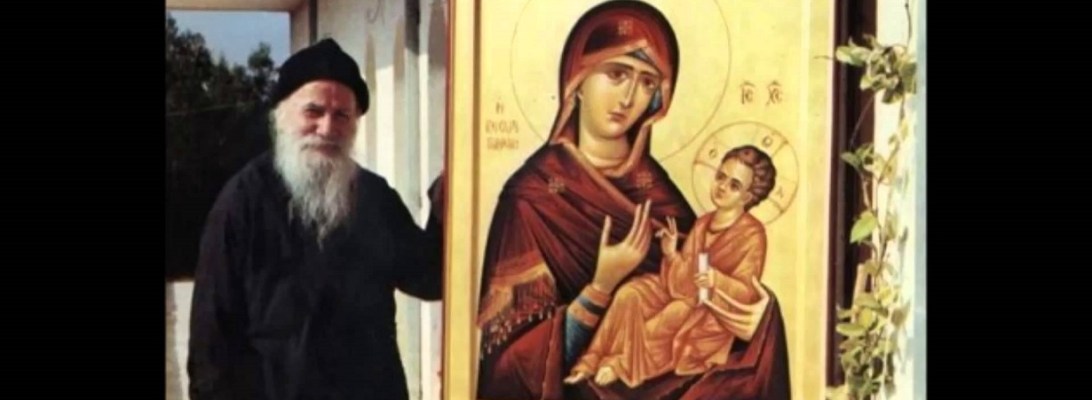
For example, read what then-Elder Porphyrios said about bargain prayers and God’s “secrets.”
We shouldn’t blackmail God with our prayers. We shouldn’t ask God to release us from something, from an illness, for example, or to solve our problems, but we should ask for strength and support from Him to bear what we have to bear. Just as He knocks discretely at the door of our soul, so we should ask discretely for what we desire and if the Lord does not respond, we should cease to ask. When God does not give us something that we ask for insistently, then He has His reasons. God, too, has His ‘secrets.’ Since we believe in His good providence, since we believe that He knows everything about our lives and that He always desires what is good, why should we not trust Him? Let us pray naturally and gently, without forcing ourself and without passion. We know that past present and future are all known, ‘open and laid bare’ before God. As Saint Paul says, ‘Before him no creature is hidden, but all are open and laid bare to His eyes.’ We should not insist; such persistence does harm instead of good. We shouldn’t continue relentlessly in order to acquire what we want; rather we should leave all things to the will of God. Because the more we pursue something, the more it runs away from us. So what is required is patience, faith and composure. And if we forget it, the Lord never forgets; and if it is for our good, He will give us what we require when we require it.
God has His secrets, His reasons, the tender wisdom of love that sees all, knows all, and gives all, according to the season, for all our needs.

 It’s about to be Memorial Day again. Remembering time. Truth is, what we have to remember is more than we can handle. People die, in a war, and that’s already too much to grasp. But there are other casualties. Hundreds of them, for every soldier, on both sides. These casualties seem small, and they sometimes fly past so quickly that there’s no time to name them. But the empty places left by these small deaths remain, and there will be years and years to feel the loss, after it’s too late to prevent it. Continue reading




 Melinda Johnson, Writing