Becoming Invisible

Light comes through an open window in a dark room

It’s a cultural flaw, observed and decried by many, that the marks of a woman’s increasing maturity reduce society’s belief in her sexual appeal and thus render her invisible. We lose our value, apparently, as our skin wrinkles and our tolerance for superficial thinking deteriorates.

I deplore this trend, but it is not what I am writing about this evening. There is another kind of invisibility, one that manifests itself gradually along the slopes and valleys of our spiritual journeying, and I believe it is the reward of dogged perseverance.

First, we must agree that visibility is a complex thing, and I am speaking here only of that type measured by the human eye’s ability to perceive it. It is a manifest thing, approached with lens, pupil, retina, nerve.  What is visible can be detected on the skin, on the page, outside the window. What is invisible cannot. But I hope you will stretch a point and let me gather audible, tangible things under this useful word. Eyes, ears, nerves in the tips of our fingers – these are the managers of our outer world.

If we live vigorously, seeking to discover and perfect ourselves, our reality shifts across time so that where once it was mostly visible, mostly outward facing, it becomes mostly invisible, perhaps inward facing, perhaps upward. I don’t know that this journey is linear. In my experience, its facets develop at different times, on different levels. A child’s play may begin with a round, red ball, mostly understood with the eyes and fingers, and in just a few years, the same child may stumble into the wilderness of imagination and spend hours engaged in intricate games that will remain invisible to everyone but herself. But the same child may have no patience, and her lack of patience may be completely visible for decades after she has learned to rely on the invisible people and places of her imagination.

A person living in this world will never be completely visible or completely invisible. But the trend is there – the chain of insight. There are milestones on this path that I was pondering tonight, washing the dinner dishes with my hands, talking to the puppy with my voice, sorting words and impressions in the quiet of my own mind.

Patience

Patience is an intangible thing, but impatience is not. Our impatience is often loud and always visible – our faces change, our voices grow shrill, our hands and feet move quickly and irritably. Patience is the invisible thing. When you are patient, you are not grimacing or raising your voice. Your hands and feet are under your control, and so is your irritation. If your patience is visible, it’s not patience. It’s impatience with a mask on, struggling to make a point.

It reminds me of something my father said the summer he refinished the picnic table. When he began the project, the table looked bad. The finish was peeling off and the wood was discolored. After hours of labor, sweat, and persistence, the table looked wonderful. “Now you don’t even notice it,” he said, ruefully. “It just blends in.” The eyesore stood out; the result of his effort looked normal and unremarkable.

Patience is like that.

Self-Awareness

Like patience, this is a gift most visible in its absence. A person who speaks his words without hearing them, who can’t stand outside his opinions, will commit one solecism after another. He will be the target of frustration or disgust, but he won’t receive these incoming signals.  Ironically, a person is much less visible when he can “see” himself, when he can hear what others are saying to him and about him and believe that it might be accurate. He is an integral part of the human whole, not the sore thumb protruding from it.

I think humility is part of this awareness, humility and perception. You need perception to understand what the world believes you are contributing to it, but you also need humility to accept what you perceive when it isn’t attractive or simple to repair.

Moving Inward

Much of what disappears from the visible world only moves into the invisible world. This is literally true in the case of death. A person leaves the physical world and enters the spiritual world fully. We bury the body, and cling to love and memory, but nothing that remains to us is visible. But what are we removing from sight when we become patient and self-aware? Has something died in us? Are we burying ourselves in the stifling grip of self-control?

It happens. But I think it happens in error, or as a forward, but not final, step. Patience becomes possible when we are able to relieve our own irritation, when we can soothe or readjust ourselves internally without producing visible signs of the process. We can talk ourselves out of reacting, and actually heal the aggravating feeling behind it. Self-awareness depends on a parallel skill – it’s the ability to believe what we perceive from others, where patience is the ability to believe what we tell ourselves.

Instead…

Because patience is the most elusive of the gifts I seek in my own life, my meditations at this point left self-awareness behind and focused to a finer point. From visible to invisible, from outer world to inner world, what is the power behind the shift? The silent words that bring me peace and stamina now were not effective, or even available, to me at earlier points in my life. Why are they now?

You answer that question with your own experience, as you must, and I can answer it with mine. For me, it all comes to an upward spiral of imagination, a circular stairway deeper and higher into the mind. Where once imagination was a plaything, or a comfort in loneliness or distress, I believe it’s evolving into the currency of my spiritual existence. It is the reason I can experience the substance of my own thoughts. Imagination makes what I learn visible to me. Yes, visible! Imagination is the inward eye, the sights and songs and memories that are deeply personal, deeply spiritual, essential as air and water are essential. But only because it is no longer fictional. Instead of creating what is not, imagination clothes the bones of truth. If we are experiential beings, imagination is the first small leap into eternity. It is our first experience of the life beyond life, outside of eyes and hands and bodily impressions.

We become invisible only in one dimension. In another, we begin, finally, to appear.

-Photo by Jon Eric Marababol on Unsplash

A Great Light

Hand reaching out of darkness into light

When Hurricane Katrina came ashore on August 29, 2005, my husband was stationed at the Seabee base in Gulfport, MS. The flat, sandy coastline offered no resistance. The little towns along its length disappeared into the surging flood. Trees, cell towers, and whole buildings went down in the wild wind. At nightfall, there was nothing to be seen but hot, wailing darkness.

But the Seabees (an affectionate and honorable term for the Navy’s Construction Battalions) are uniquely qualified to shine in moments of disaster. They are trained to arrive in a place that has absolutely nothing but the ground under their feet and construct an airstrip, a tank farm, a base, a town – whatever is needed for the people who will follow in their footsteps. In a remarkably short time, the Seabee base had power, water, and communication with the outside world, and had begun to send teams out into the surrounding towns to look for survivors and offer desperately needed assistance.

And then?

At nightfall, there was nothing to be seen but darkness….and the blazing light of the Seabee base, the only light in that devastated landscape. People walked miles, hours, through unimaginable destruction, to reach that light. They arrived at the gates, and the Seabees let them in. The officers and troops created towns in the base warehouses, stretching their military protocol and ingenuity to care for the people who came to them, the people who could see their light and responded as human beings in darkness have always responded and always will.

The storm refugees brought nothing but the clothes they stood up with and stories of horror and grief – loved ones torn out of their arms in the flood, houses washed away, hair-raising escapes out of buildings that were filling with water as they climbed out of windows or struggled to free a debris-clogged door. The world as they had known it was taken from them completely in just a few hours. With nothing left, they gazed into the darkness, and when they saw a light, they started walking. It was as simple as that.

I have come to believe that this is the role of the Church on earth. If we are the body of Christ, we are the bearers of that great light that shines on the people who sit in darkness. When nothing else remains, when the storm and the darkness have swallowed every joy and comfort, we are the people who use the tools we have been given to bring the light. We are those who build a shelter, offer nourishment, and honor grief with our hearts and with our sacraments. We are the last and the first, the only beacon remaining and the outpost of the new creation.


-Photo by Cherry Laithang on Unsplash

A Prom Memory

When I was in high school, I went to prom twice. Senior year, I went with my hilarious, charismatic Big Crush. He chose a moment to ask me when I happened to be standing under a blossoming cherry tree, in a drift of floating pink petals. Junior year, I went with the last person on earth I would have chosen.

At the small private school I attended, you were required to say “yes” to any boy who asked you, so for a month before the prom, we secretly observed “Avoid the Geeks Weeks” to escape unwanted dates. But my technique was a little flawed that first year, so I got caught out on campus by Kevin. He had a yellow rose in his hand, cut from his father’s garden, and he asked me formally, like someone in a Jane Austen movie, or someone who had been taught his lines beforehand.

According to rumor, Kevin was either developmentally delayed or had sustained a severe head injury as a little boy. He looked normal, but he was still a little boy, caught in an increasingly adult body, running eagerly after a world that was leaving him behind a little more every day. When he asked me to go to the prom with him, I felt awful. I wanted a “real” date. I was shy, and I knew I didn’t have the social credits to carry off such a disasterous prom partner. But I could see his eyes, peering hopefully at me through thick lenses, and I could sense the barely suppressed excitement in him. Rule or no rule, I couldn’t have refused. I dreaded prom night from that moment.

At the time, I didn’t know anything about the Holy Spirit, and I thought grace was the right way to execute a dance step. But I had enough humanity to recognize, on the night of the prom, that something special was happening.

Kevin arrived at my dormitory in a black tux, and we walked across campus to the building where the prom was taking place. We walked in bright moonlight, talking a little shyly to each other. He offered me his arm, like a man in an old black-and-white movie, and I held up my long, rustling skirt with my other hand.

Just before we reached our destination, we passed a little grove of lilac bushes. He paused to let me breathe in their scent, and as I stood there, surrounded by moonlight and sweet flowers, holding the arm of a little boy who would never fully achieve the manhood he wanted so desperately, my embarrassment disappeared, and I saw the moment as a gift. It was a chance to celebrate his innocent delight in the person he believed me to be, the beautiful girl on the beautiful night, the girl of his dreams. It was a chance to feel a little shame at the discrepancy between my view of him as a partner and his view of me.

Kevin died young of an illness contracted at the school where he worked as a janitor. When I heard of his death, I remembered him standing proudly by the lilacs in the moonlight, looking forward happily to a life that most of us would dread. I wonder how it turned out for him. I hope that he never lost his deep faith in the kindness of God.

-Photo by Kelly Sikkema on Unsplash

Tree Change Dolls – Why We Care

Four days ago, I discovered Tree Change Dolls. When I discovered them, the Facebook page had 23,000+ likes. I checked again at intervals, during the day, and every time, there were about 10,000 more likes. Today, four days later, there are 87,193.

Tree Change Dolls are abandoned in thrift stores, or “tip shops,” in Tasmania, until Sonia Singh finds them and recreates them. They are old Bratz dolls, or Barbie dolls – the kind of toy that make you clutch your head and mourn because all the little girls you know are walking around in a world that does not welcome or cherish womanly beauty.

But then, there is Sonia.

She washes off their terrible makeup, paints natural faces on them, and dresses them in tiny homemade clothes, provided by her mother. The result is enough to bring tears to your eyes. Their little dolly faces are full of joy – even relief? – and they look just like ordinary little girls, ready to play in the garden.

Nearly 100,000 people have watched the news video about Sonia and her dolls (see above). The response to these dolls is fascinating — perhaps especially to an Orthodox observer. The comments on Sonia’s Facebook page are my favorite part – the dolls look happy, the dolls look like my children’s friends, and (the best) “The dolls look like you gave them back their childhood.”

The rapid, overwhelmingly positive (even emotional!) response to these dolls, world-wide, says a LOT.

A lot about toys – who’s selling them, and to whom? How could a Bratz doll possibly be a good idea? Who is the person who thought it was? Why did so many people believe this person and buy the dolls?

A lot about women – women are buying the Bratz dolls, women are hating the Bratz dolls, women are LONGING for Tree Change Dolls for their daughters and even for themselves. Women are still, after centuries, struggling against the disintegrating apathy of that losing fight to be equally human, equally valued in their natural state.

A lot about problems – what Sonia is doing seems simple and obvious, now that she’s thought of it and showed us how she did it. How can the weight of a cultural trend become so heavy? If we are so relieved to see it shattered, why did we allow it in the first place? Why didn’t we all think of this, on the very first day the very first Bratz doll came out?

But perhaps the most thought-provoking response came to me from someone I know, who said, when he heard about the dolls, that it’s not so easy when it’s a person — not a doll — that you’re trying to rescue. We all want the darkness washed away, don’t we? You’d think so, until you actually tried to help someone who needed the help.

I don’t argue that. Not at all. I don’t ever forget that if solving the problem were simple, the problem would already be solved.

I think that explains the powerful response to Sonia, rescuing one little doll at a time.

We wish it could happen for us that way. We wish we could heal our loved ones so simply, so gently, and so completely. We wish that we ourselves could be so well healed.

So we click on Sonia’s video and watch her do it again – watch her wash the make-up off the tiny face, paint the eyes, and the smile, and the freckles, watch her mom knit the tiny sweater and sew the tiny skirt, and we see the recreated doll sitting in the grass in Sonia’s garden. Sitting there for all of us who wish we could make it to that place ourselves. Clothed and in our right mind. In the garden.

Never confuse the person formed in the image of God, with the evil that is in him; because evil is but a chance misfortune, an illness, a devilish reverie. But the very essence of the person is the image of God, and this remains in him despite every disfigurement.

— St. John of Kronstadt

Saint Porphyrios on Blackmailing God

Bargaining with God in prayer is such a common human behavior that it’s part of our culture. How many times have you seen a character in a movie, hands clasped, drenched in tears, promising, “God, if you will just [fill in the blank], I promise you I’ll never [fill in the blank] again!” Scenes like this appear in novels too, and many of us have caught ourselves doing something like this in real life. “I know I haven’t been to church recently, but if you help me with this, God, I promise I’ll go to church every week.”

Sometimes bargaining happens because we’re trying to get out of the consequences of a bad choice. We are, in essence, asking God to overlook our mistake just this once, get us out of it, and accept as His “reward” our promise that we won’t make this mistake again. This attempt at escape makes several interesting assumptions – not the least of which is that God, staring at us in the midst of our self-made disaster, believes us when we say we won’t do it again.

But perhaps more often, bargaining happens when we are struggling on the brink of despair. We are grasping at what we perceive as our only hope – Divine intervention and protection. This is a good impulse in many ways. God is always our hope and our protector. But desperation can be short-sighted.

As Orthodox Christians, we turn to the saints and fathers of our faith to help us when we can’t solve what confronts us. Their long, long sight into the life of the human spirit can help us resist despair and relax in hope.

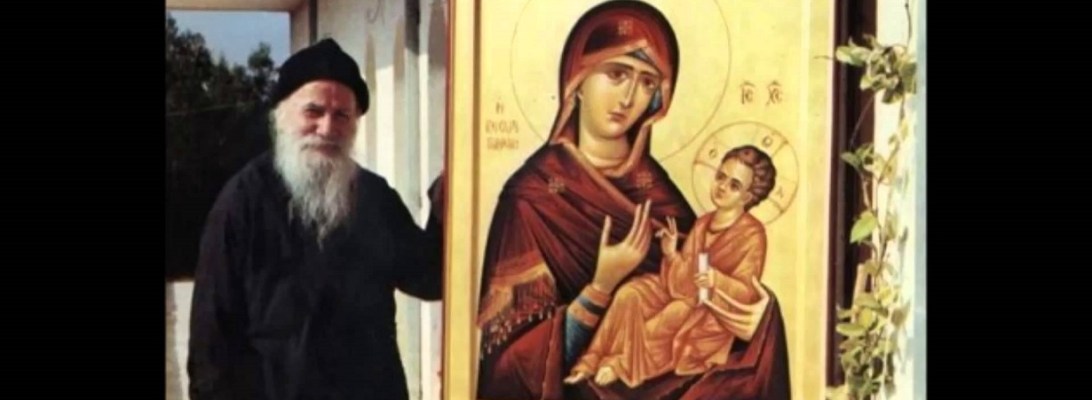
For example, read what then-Elder Porphyrios said about bargain prayers and God’s “secrets.”

We shouldn’t blackmail God with our prayers. We shouldn’t ask God to release us from something, from an illness, for example, or to solve our problems, but we should ask for strength and support from Him to bear what we have to bear. Just as He knocks discretely at the door of our soul, so we should ask discretely for what we desire and if the Lord does not respond, we should cease to ask. When God does not give us something that we ask for insistently, then He has His reasons. God, too, has His ‘secrets.’ Since we believe in His good providence, since we believe that He knows everything about our lives and that He always desires what is good, why should we not trust Him? Let us pray naturally and gently, without forcing ourself and without passion. We know that past present and future are all known, ‘open and laid bare’ before God. As Saint Paul says, ‘Before him no creature is hidden, but all are open and laid bare to His eyes.’ We should not insist; such persistence does harm instead of good. We shouldn’t continue relentlessly in order to acquire what we want; rather we should leave all things to the will of God. Because the more we pursue something, the more it runs away from us. So what is required is patience, faith and composure. And if we forget it, the Lord never forgets; and if it is for our good, He will give us what we require when we require it.

God has His secrets, His reasons, the tender wisdom of love that sees all, knows all, and gives all, according to the season, for all our needs.

-Photo from a recording of St. Porphyrios praying the Jesus Prayer