My Literary Life in 2018

If you don’t have a ladder and you want fruit from a tree, you can lean your whole weight on its slender trunk and shake the tree. If you shake patiently, the fruit will tumble down to you.

This is the year the fruit has tumbled down to me! Almost daily, something encouraging happens, and no sooner have I picked up the gift and savored it, but another gift drops into my hands. In honor of these many blessings, I’ve decided to write a list of all the good things that have happened to me, Melinda Johnson, Writing, this year.

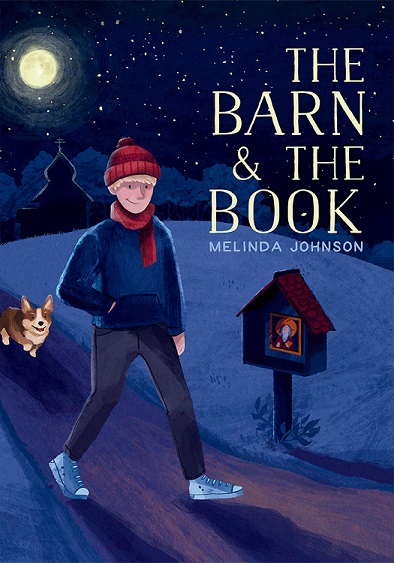
The Barn and the Book: The second book in the Sam and Saucer series just released this month! This is the sequel to Shepherding Sam and follows the boy and his corgi as Christmas approaches. You can read more about it here.

Painting Angels: At the publisher’s request, I drafted the third Sam and Saucer book, and it’s scheduled for release in June 2019! In Painting Angels, Sam and his nemesis, Macrina, square off.

Piggy in Heaven: Paraclete Press decided to publish the story I wrote about our guinea pig. It’s coming out on January 8, and I can’t wait! Read all about it. This book is available for preorder.

More to the Story: I launched my own picture-book review site, and within a few weeks, four publishers had requested reviews! That was exciting. I love writing about books, and I love books with pictures. Follow me here.

Letters to Saint Lydia audiobook edition: I’ve already shared this good news! I’m working with a wonderful young woman to create the Audible edition of my first book, and she’s amazing! This book is already available in paperback and Kindle editions.

The Book Project That Shall Not Be Named: This is a secret. Shhhhh. It’s an awesome project I’m working on with friends.

Abigail Counts Her Way Home: I wrote another board book (I like board books! I like pictures!) and it’s through the first round with a publisher, and I’ve got two more publishers to try for if need be.

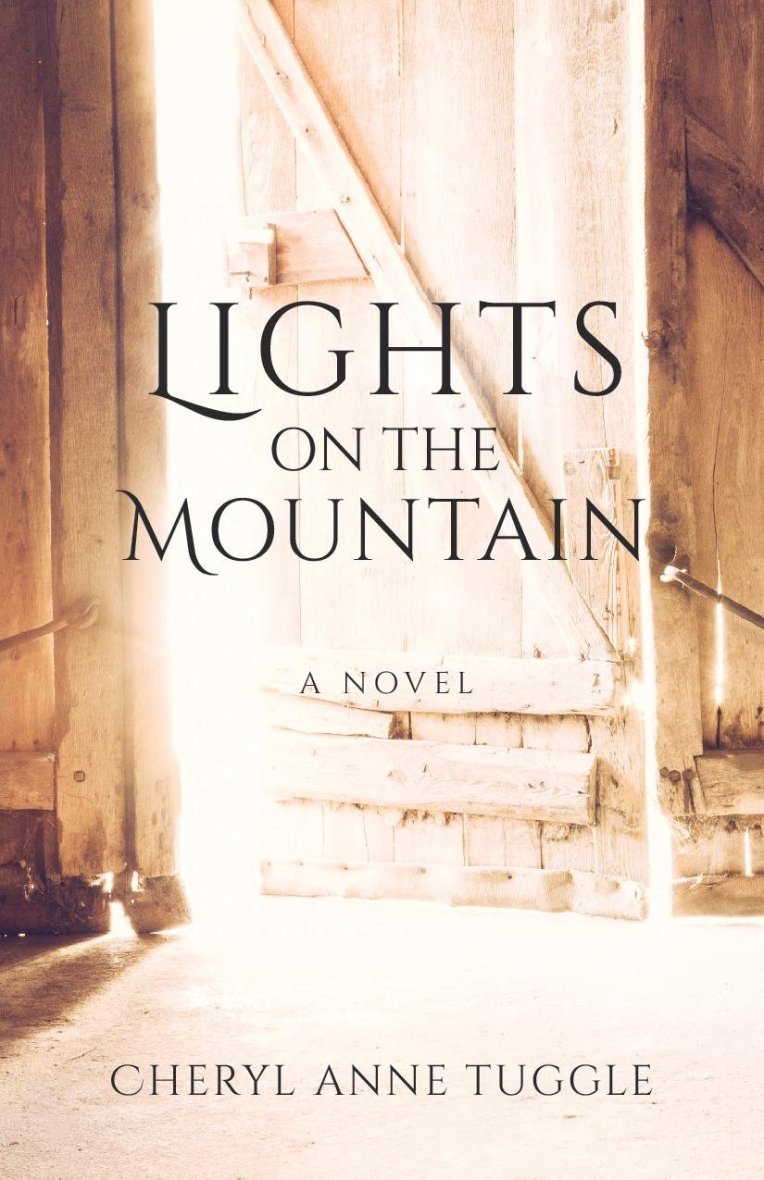
Attributed Endorsement on Lights on the Mountain and The Dog in the Dentist Chair: Book reviewing is fun! I wrote advance reviews of both books, and you’ll find me in the “Editorial Review” section for these two!

First-ever Ancient Faith Women’s Retreat: This is an exciting accomplishment at work. I didn’t write it, but I did organize it. In fact, I invented it! I’m very excited to be hosting this national women’s gathering in just a few weeks. We sold out – filled the venue to the gills. It’s going to be wonderful.

Romanian edition of Letters to Saint Lydia: My first novel has been translated and just released in a beautiful Romanian edition from Editura Sophia! You can order it here. It’s exciting to be contributing to Orthodox Christian literature in Romania!

There are other projects percolating in my mind. I am so happy in the world of words that has been given to me!

Photo by Ian Baldwin on Unsplash

NEW! The Barn and the Book

First came Shepherding Sam – the story of a lonely, angry third-grader named Sam and Saucer, the wise and funny little corgi who befriends him. Sam and Saucer are back and getting ready for Christmas in The Barn and the Book, releasing today from Ancient Faith Publishing!

Barn and the Book cover high res file smallThe Barn and the Book

Sam wants to know if animals (especially Saucer!) can speak at midnight on Christmas Eve. Grace and Macrina are competing to write a story, and Elias is losing his patience. Meanwhile, Sister Anna hopes God will rescue her from teaching Sunday school. Christmas is coming, but hearts are full of secrets and frustrations. The Barn and the Book is a story about the traps we build when we try to see in the dark. We tumble into trouble and confusion on our own, but God can steer us clear of our traps and shine His kindly light into our darkness. This is a chapter book for independent readers aged 7-12, and a read-aloud story for the whole family.

Print, Ebook, and Audio Editions

The print edition of The Barn on the Book is available from the publisher and on Amazon. The ebook edition is available for Kindle and Nook, as an iBook, and on OrthodoxChristianEbooks.com.

Remember Book 1?

Meet Saucer the corgi and his boy Sam in the first book, Shepherding Sam! Sam’s Aunt Eva says he s like a tornado he causes a ruckus everywhere he goes. But Aunt Eva won t give up on Sam, and neither will Saucer, the monastery s corgi puppy. Saucer lives at the monastery, but he dreams of herding sheep. With no sheep in his life, Saucer tries to herd everyone else farm animals, nuns, and especially Sam. Sam doesn’t want to follow anyone, not even a funny puppy. But Saucer knows that if he just keeps trying, he can bring this lonely boy back to the flock.

Meet Ferdinand!

As these two books were being written, I sometimes joked about my imaginary corgi. But now I have a real one! This is Ferdinand – and no, we didn’t bring him home for “book research.” We just love corgis! Just like his imaginary counterpart, Ferdinand is funny, intelligent, loving, strong-minded, curious, and extremely fond of chewing socks! You’ll notice that his ears are flopped over in this picture, and that’s because it’s one of his baby pictures. Corgis are born with their ears flopped over, but they stand up and start swiveling around when the puppy is a few months old.

Ferdinand on the rock garden 9 29 17.jpg

Letters to Saint Lydia Actress for Audible

It gives me great joy to present Priscilla Sabourin, actress, singer-songwriter, all-around-good-sort, and THE VOICE OF TEEN LYDIA in the upcoming release of Letters to Saint Lydia on Audible.com!

Priscilla Sabourin

When I was writing this book, I could “hear” teen Lydia and Saint Lydia in my mind as I composed their letters to each other. There’s something miraculous about experiencing Lydia’s voice – living, breathing, speaking – outside my imagination. The book suddenly has another dimension.

I chose Priscilla for the role because her voice has that mysterious quality you find in a girl who’s poised in the doorway. Her wings are brushing the past and testing the future. Venturing, lingering. It’s the voice for a coming-of-age story. I can’t wait to share this with you! I heard the first recording last night, flung off my headset, and shouted, “It’s perfect!”

Photo credit: Molly Maddex Sabourin


Cover photo by Rob Laughter on Unsplash

Facets of Close Reading

In his Foreword to the Second Edition of The Lord of the Rings, J. R. R. Tolkien remarks testily, “As for any inner meaning or ‘message’, it has in the intention of the author none. It is neither allegorical nor topical….I cordially dislike allegory in all its manifestations, and always have done so since I grew old and wary enough to detect its presence. I much prefer history, true or feigned, with its varied applicability to the thought and experience of readers. I think that many confuse ‘applicability’ with ‘allegory’; but the one resides in the freedom of the reader, and the other in the purposed domination of the author.”

Feigned History

A most fascinating phrase in this rich paragraph is the reference to “history, true or feigned.” We are so accustomed to defining history as the record of what has been true that this seems at first like an attempt to split hairs, perhaps a hopeful weapon against readers who were too ready to assume references in his tales to the World War where Tolkien vigorously denied them. Yet to a man who had invented a complex imaginary world and lived in it for decades, there could be nothing surprising in the idea of “feigned history.” Having taken the giant step from literal to imaginative reality, he could find no difficulty in treating the record of imagined people and events with the same discipline and care expected from real-world chronicles and scholars.

But a record, or study, of what can be found in a work of fiction may not so easily be categorized as “true” or “feigned.” Tolkien, existing in “true” life, must draw on materials from the Creator’s world to create a world of his own, and the reader’s pursuit of his meaning may undermine the idea of allegory as a tool of “domination.” Tolkien notes, “An author cannot of course remain wholly unaffected by his experience, but the ways in which a story-germ uses the soil of experience are extremely complex, and attempts to define the process are at best guesses from evidence that is inadequate and ambiguous.” (Read my observations on this subject.) He strikes here the head of the nail that drives through critical debates over authorial intention and the existence of any text as an entity independent of its creator. It is also a touch-point between spiritual and literary theology, a bump against the reality that like God, we must create from our own substance, but unlike God, we are not the originator of that substance.

Allegory

“Allegory,” we are told, is “a story, poem, or picture that can be interpreted to reveal a hidden meaning, typically a moral or political one.” By this definition, despite Tolkien, every literary work is an allegory.  There is something about our means of communicating that cannot be one-dimensional. “All these things spoke Jesus unto the multitude in parables; and without a parable spoke he not unto them” (Matthew 13:34). Language itself is allegorical at the most basic level – words describe meaning the way music notes depict sound. The marks themselves are nothing but what we agree to attribute to them. Communication is an equation, an exchange of factors that must always be interpreted to exist at all. Thus, a writer striving to escape interpretation is a paradox.

Alfred Tennyson is a good example, a witness against his own attempt at escape. Despite his expressed irritation with attempts to pinpoint such “hidden meaning” in his poems, he was the master of deeply symbolic, allusive language. The smallest details of vocabulary, meter, and description are laden with “meaning.” (But that is a subject for another day.) “I am a part of all that I have met,” says Ulysses, in the poem that bears his name. This is a statement he makes to himself, claiming himself as an influence on the lives of others. But so must those others be a part of him. So are we all constantly brushing against each other, leaving streaks of color, infringement, motivation, reaction, inspiration. So are we all constantly affected and affecting.

Interpretation

In my own years of reading and seeking, I have arrived at a sense that it is not the impulse to interpret and decode that is at issue. Rather, it is the counter-impulse to accept only one interpretation, to open the door in search of meaning and then slam it shut as soon as the first glimmer appears. Tennyson abhorred interpretation that reduced his poems to mathematical simplicity – this means that, this stands for that, as if the poem were a code and a single idea could decipher and replace it. This kind of reading inevitably reduces literature, or any art form, to one dimension. It collapses tension, removes whatever is dynamic or uncertain, and flattens the living entity into one cramped and stunted viewpoint. Too much is lost, too little gained.

The same tight-fisted over-simplification appears in religious life too frequently as well. God eludes us, and instead of pondering the largess of Infinity, we strive feverishly to equate Him with something more manageable. When it is used in this way, allegory is guilty as Tolkien charges it. It is an imposition rather than an interpretation, a willful choice of anxiety over comprehension. Again we collapse the tension we cannot handle.

Meaning

Meaning should be the fruit of any quest for meaning. It seems too obvious to need stating, but replacing the multi-faceted gem with the plain line-drawing is an unworthy fruit, or no fruit at all. Replacement is not the goal.

Real art explores and celebrates what is beyond its ability to depict. “Parables” are necessary because they allow the indescribable mysteries to be carried along in the limitless spaces left for them around the words and ideas we are able to describe. We “read between the lines” instinctively because we are created this way. We know there is “more to this than meets the eye.” We are wired to seek revelation because we are created in the image of the Revelator. Our ability to use this gift will be in direct proportion to our faithful confidence that our own perceptions are a tool of the revelation, but not its final boundaries.

We read closely not to reduce or replace, but to enter fully into what is present, what might be present, in the text and in ourselves. Done correctly, reading enlarges the text as we discern layer upon layer within it. Whatever we find within it, and within ourselves, the object is not to achieve the inner stillness of single meaning. The object is to draw near to our own incarnational connection with the Infinite.


Photo by Felipe Furtado on Unsplash

Lights on the Mountain: A Novel, by Cheryl Anne Tuggle

Cheryl Anne’s writing reminded me at first of a wood carving. There’s that same firm, careful line in her imagery, that prick of wonder that the solid words drop the reader so deeply into the picture, into it and through it, into the story.

The sound and cadence of the words, both in dialog and narrative, are well suited to the characters and their natural setting. That setting is fully, carefully experienced for all five senses, yet lightly, clearly, never bogging down.

But as I fell deeper and deeper into the novel, the wood carving became a tapestry, thick with colorful threads, embroidered with subtle illusion, possessed of layers. A thread would seem to drop, but then it would appear again, like warp and weft, weaving in and out as first one thread and then another was brought to the fore and pressed back again.

At some point in the story, it became difficult to remember that it is fiction. So much of the deepest, hardest parts of life are written into these pages. Our human struggle with the idea of suffering, and the ways we come to terms with it, our temptation to grieve and doubt, our tumultuous journey up and down the waves of self-discovery are all there, and if you have lived through any of them yourself, you will feel a strong sense of recognition. This is the best kind of fiction, the kind that is woven together out of well-learned fact.

The novel has an extra depth for me as it takes place near where I now live. The area’s history, the evolution of these green hills from their farming roots, through industrialization, depression, and, more recently, new growth, has been the backdrop of my life in recent months. This lent an extra fascination and truthfulness to Cheryl Anne’s tale for me, suggesting deep knowledge or excellent research on her part.

As a fellow Orthodox Christian writer, I must add that this book is a major landmark for Orthodox literature as a possible genre. It is exquisitely well written, and at no point does it throw itself into the theological arms of its reader and beg for loyalty. Its power is earned, its artistry is fully executed, and it sets aside the myriad stereotypes about novels written by Christians.

If, as we say, Orthodoxy is not a religion but a way of life, our art should not be amateur or overdrawn. Beauty demands beauty. If we follow the ascetic path in our spiritual life, how much must we also command its endurance in our creative life. It is a great satisfaction to read this book and feel how deeply I may ponder it and find no effort lacking. All of the threads are fully spun, all woven together. It is a well-made whole.

Lights on the Mountain is available HERE.

Lights on the Mountain: A Novel by Cheryl Anne Tuggle

Cover image: Paraclete Press

Featured image photo: Timothy Eberly on Unsplash

Mercy and Complexity

One of the blessing curses of being a writer is the refined ability to step inside another character’s worldview. You do this so that you can write the character, but the longer I live, the more my brain tries to hop worldviews in real life. To do it well, you must be able to envision motives and emotions for an identity completely separate from your own. But, especially if you’re going to do it in real life, you must complete the exercise without falling into the trap of believing you can actually read another person’s mind.

Although there are genuinely malicious people in the world, I don’t believe they are the majority, or even close to it. Most people, no matter how wrong-headed they appear to their peers, believe there is a valuable or at least necessary reason for their choices. If you are writing this wrong-headed person, or pondering them in real life, you will quickly discover that perception and empathy create confusion.

What’s the first dysfunctional human situation from your own life that springs to mind? (Don’t raise your hand or shout it out. Just think of one.) If you climb out of your own position in the situation and walk around the table, so to speak, it will become harder and harder to decide who is the “good guy” and who is the “bad guy.” It seems to me that the core of our human judgment of other humans rests in whether we think they meant well. Were they trying to do something they thought was good? Were they trying to do harm?

Our cultural paradigm is to solve or explain a situation by identifying a protagonist and an antagonist. We can then support the one and the condemn the other with an easy mind.

But the more you seek the details of human psychological and spiritual complexity, the more difficult it becomes to decide who is the antagonist. “There is no one who lives who is without sin.” We are all antagonists. But all creation is lifted up in Christ. We are all protagonists.

This is not an argument for relativism. There are good acts and evil acts, good motives and evil motives. But we have lost our desire or ability, as a culture, to accommodate the presence of spiritual tension in everyone around us, and in ourselves.

Perception, empathy, justice, mercy – all of these open us to unwanted depths of meaning and accountability. We are too tired and frightened to be attracted by the chance to understand and care for each other. And our weariness and fear are strengthened every day by the failure of our peers to understand us and care for us. That is the cycle that wants breaking, in my view.

-Photo by Akshay Paatil on Unsplash

Writing Around the Ten Commandments

Consider the following plot (a real plot, from a novel I’ve read, but with names changed to prevent a spoiler). Abigail is engaged to Bert, and Christopher is engaged to Danielle. Abigail and Christopher meet at a house party at a country estate, and of course, they fall in love. But because they live in a bygone era, honor takes precedence over emotion. Abigail returns home and marries Bert. Christopher returns home and marries Danielle. Years pass, events conspire. Bert suffers a terminal illness that terminates him. Danielle has the misfortune to be directly under a German bomb.

Drum roll, swelling tide of romantic orchestral music. Abigail and Christopher meet again, and to the great delight of all their friends and relations (who never liked either Bert or Danielle very much), Abigail and Christopher marry.

Is something wrong with this picture? What’s going on here for the reader? What about the writer?

As the reader, I’m being urged to hope for the breakdown of two marriages, and when Bert and Danielle die, I’m encouraged to heave a sigh of relief and cheer on Abigail and Christopher as they move toward their reunion.

As the writer, what would I be doing? The author of this novel happens to be long dead, so there’s no way of knowing what she was thinking as she wrote. But it is fair to state that she arranged her novel in such a way that the eventual marriage of Abigail and Christopher is what every right-thinking character (and reader?) hopes will occur.

One voice in my head says, “Oh, come on already. It’s just a story, and at least they didn’t commit adultery.” But the other voice says, “Isn’t there something faintly adulterous about writing this story? Deliberately killing off the intentionally unappealing spouses so the two attractive people can marry?”

I wonder at what point our fictional acts as writers touch on our real-life morality as human beings. Does it matter if or how the story argues for an ideal?

At what point could a fictional creation become a real-life trespass, a figurative breaking of the commandments? Are the characters and events part or not part of their literary creator? Is there no moral connection between fiction writing and real life?

What do you think?

-Photo by Ben Rosett on Unsplash

Piggy in Heaven

Such a pile of emotions all at once! I am so happy to have a picture book contract from Paraclete Press and so glad that our much-loved Piggy will be the main character, and so sad, a year later, that Piggy’s book is about Piggy in Heaven.

Piggy was only part of our earthly live for a little over a year, but he was so special and so loved. We still miss him.

I learned many things from this furry little creature, and one of the most important is simply that love is love. All of it. It all comes from the same Source, and it is beautiful in its time and in its variety.

And by the same token, grief is grief. Our immersion in it may be smaller or more complete, but I believe we grieve because we feel our love is blocked off from the person (or guinea pig!) that we love, by their physical absence from us.

I wrote this story, Piggy in Heaven, as part of our grieving. I saw it all clearly with my inward eyes, and that was comforting.

-Photo by Aaron Burden on Unsplash

Hearing RAchmaninoff’s All-Night Vigil

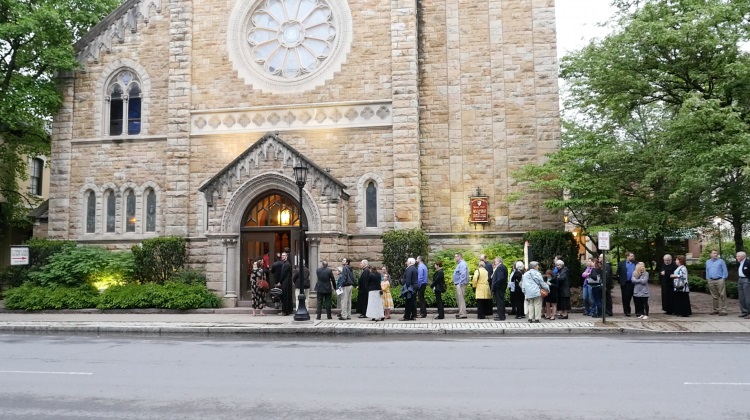
If you attended the Chamber Choir of St. Tikhon’s performance of Rachmaninoff’s All-Night Vigil on May 26, 2018, you will find these words a poor substitute for your memories of the event. If you did not, let me try to describe for you what it was like.

We sat in rows of wooden chairs under the steep arc of a mosaiced cathedral ceiling. The lights were on. We were all awake, and the cushions were not soft enough to induce drowsiness (as sometimes happens at an evening concert…). The stage, if you can call it that, was simply the stone steps built into the cathedral floor, leading up to the altar area. The choir wore black. There were no special effects.

The 25 musicians filed out from a door at the side, carrying their music and smiling at us. Their faces showed anticipation and focus. They were already poised, already concentrating on the first note. There were no instruments. There was nothing at all except the acoustic space, the choir, and a gifted conductor.

The music began.

It was immediately transcendent. One moment, I was sitting in a chair holding a program. The next moment, I was gone.

This music is like water. Deep, clear, abundant water that flows into every opening. You hear it inside yourself, in all the holy spaces you sense are present behind your ribs and between your ears. It was a kind of immersion that is difficult to find or describe here on this planet where gravity is a fact and we expect pressure, even strangulation, to result when we are filled so completely with something outside ourselves.

I am not a mathematician, so you will forgive me when I abandon numerical sense and say the sound was 100% natural, bodily even, and 100% ethereal, shockingly intense and utterly, weightlessly peaceful. The paradox draws the mind to Christ, a resurrection in which all creation is lifted up – our lungs, our ears, our vocal chords, the wet, sinuous workings of our physical instrument baptized and redeemed in the celestial grace of this prayer they are so beautifully created to offer up.

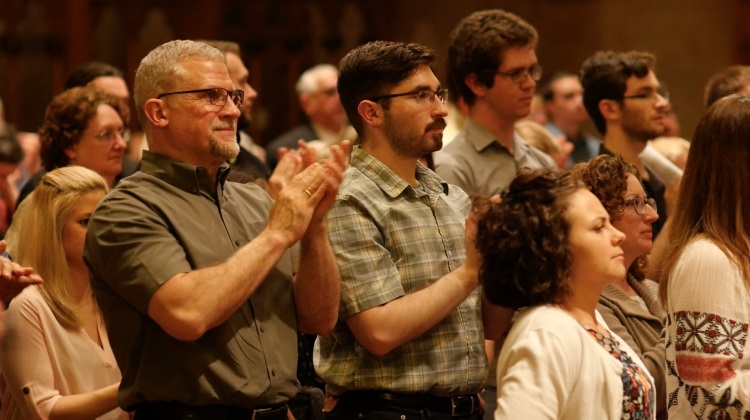
The audience sat still. In the pauses between sections, no one spoke. We were totally absorbed. Time wandered away from us, and when the music ended, we rose as one body. It was the most spontaneous standing ovation I’ve seen in a long, long time.​