Board Book Story of Saint Casilda of Toledo

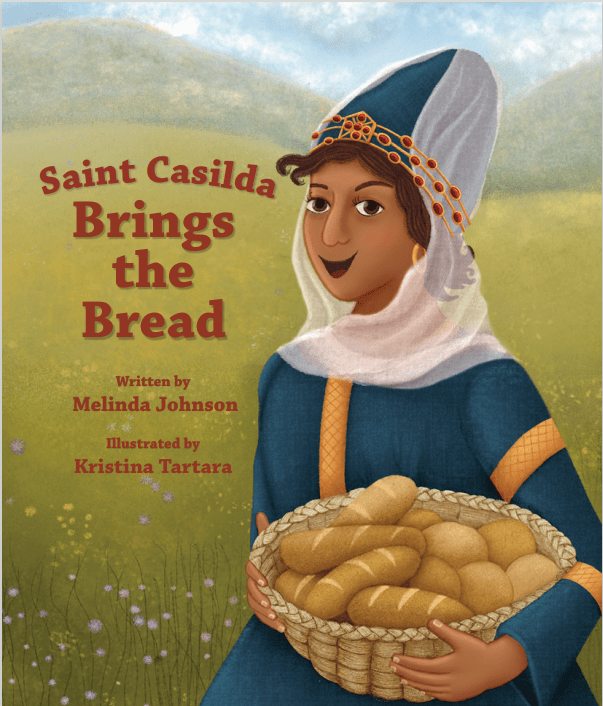
Saint Casilda of Toledo was the daughter of the Berber ruler of Toledo in 1oth-century Spain. A faithful Muslim, Casilda still felt compassion for her father’s Christian prisoners and found the courage to visit the prison with bread for them hidden in the folds of her dress. This led her into grave danger, either from her father himself or from his soldiers, according to varying accounts. But in a moment of crisis, Casilda experienced a gorgeous, fragrant miracle that saved her life.

I first encountered Saint Casilda while researching Seven Holy Women. Her story fascinated me, so I included her among the seven, and my friend Melissa Naasko wrote Casilda’s chapter. Melissa felt so befriended by Casilda that she commissioned the only Orthodox icon of Caslida of which we are aware.

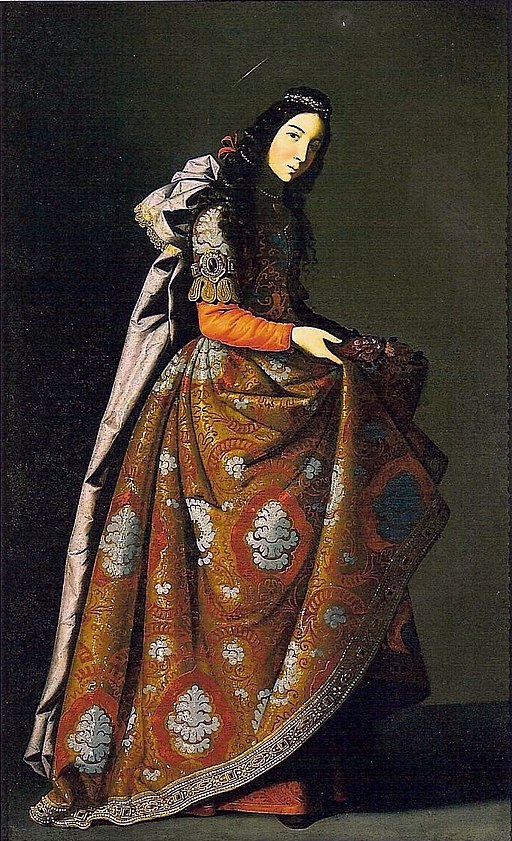
Fine art paintings and other western images of Casilda are easily found (see below). Because of the time when she lived (the turn of the first millennium), she is venerated in both Orthodox and Catholic traditions. The Catholics seem to know more about her, possibly because she lived in Spain, and I suspect this accounts for the dearth of iconography.

Saint Casilda of Toledo, by Francisco de Zurbarán – Thyssen-Bornemisza Museum.

Once again, Kristina Tartara illustrated my story for this SVS Press board book. I love working with Kristina! As always, her research brings a wealth of contextual detail to her colorful illustrations.

You’ll see evidence of Kristina’s remarkable patience as well in the illustration of Saint Casilda with her arms full of beautiful, hand-drawn-one-by-one roses. Kristina also kept up her tradition of granting the main character tiny animal friends to accompany her on her adventures. Be sure to look for a friendly mouse or two!

Saint Casilda Brings the Bread is available from SVSPress and on the Ancient Faith Store and Amazon.

Tension around the Table

One of the blessing curses of being a writer is the refined ability to step inside another character’s worldview. You do this so that you can write the character, but the longer I live, the more my brain tries to hop worldviews in real life. To do it well, you must be able to envision motives and emotions for an identity completely separate from your own. But, especially if you’re going to do it in real life, you must complete the exercise without falling into the trap of believing you can actually read another person’s mind.

Although there are genuinely malicious people in the world, I don’t believe they are the majority, or even close to it. Most people, no matter how wrong-headed they appear to their peers, believe there is a valuable or at least necessary reason for their choices. If you are writing this wrong-headed person, or pondering them in real life, you will quickly discover that perception and empathy create confusion.

What’s the first dysfunctional human situation from your own life that springs to mind? (Don’t raise your hand or shout it out. Just think of one.) If you climb out of your own position in the situation and walk around the table, so to speak, it will become harder and harder to decide who is the “good guy” and who is the “bad guy.” It seems to me that the core of our human judgment of other humans rests in whether we think they meant well. Were they trying to do something they thought was good? Were they trying to do harm?

Our cultural paradigm is to solve or explain a situation by identifying a protagonist and an antagonist. We can then support the one and condemn the other with an easy mind.

But the more you seek the details of human psychological and spiritual complexity, the more difficult it becomes to decide who is the antagonist. “There is no one who lives who is without sin.” We are all antagonists. But all creation is lifted up in Christ. We are all protagonists.

This is not an argument for relativism. There are good acts and evil acts, good motives and evil motives. But we have lost our desire or ability, as a culture, to accommodate the presence of spiritual tension in everyone around us, and in ourselves.

Perception, empathy, justice, mercy – all of these open us to unwanted depths of meaning and accountability. We are too tired and frightened to be attracted by the chance to understand and care for each other. And our weariness and fear are strengthened every day by the failure of our peers to understand us and care for us. That is the cycle that wants breaking, in my view.

Photo by Dxaxoxfz on Unsplash

How I Planted a Willow Tree

Our back yard is longer than it is wide. It’s about 1.7 acres, and the lingering woods still cover most of the last .7 acre. If you’re standing on the deck looking at the woods, you notice a bare patch on the left. The woods break, and there’s a swampy stretch of soft earth and weedy hillocks for a few yards before you reach the towering evergreens marking the property line on that side. From its shape, it might once have been the end of a very long drive way. The deer wander through it, passing on to the trees.

During some recent moment of quiet, I remember telling myself it would be nice to plant trees in that bare patch, bringing the woods across to the evergreens. I was eating breakfast, I think. Or staring out a window thinking about saving the planet.

The moment passed. The day continued. The thought vanished.

In a wholly unrelated instance, months before, my mama gave me a tree for my birthday. She doesn’t live nearby, so we researched “trees that deer might not eat,” and she sent me a check, with the understanding that I would buy the tree at a local nursery. Our research and my love of flowering trees led us to select pink dogwood as the object of our desire.

This is not my tree. Photo by Jonathan Hanna on Unsplash

I waited through the end of winter, mentally dropping a pink dogwood in various spots and deciding whether it would do well there. As the spring advanced, I asked the farmer who mows our lawn if he could dig a hole when I had the tree. He said yes and suggested a different spot than the one I’d thought of.

I kept looking and picked another location. The not-yet-present pink dogwood had now been mentally located in three places.

Spring came, sun shone, weather warmed, and I began tree shopping in earnest. The first place had one white dogwood left, no pink. I dithered, but decided to check the other place.

The other place? Had Everything! But no pink dogwood. Apple trees, cherry trees, grape vines, blueberry bushes, oak and maple and holly and too many others to recall. But no pink dogwood.

Voila! The perfect conditions for my brain to run wild! I called my mama, and we debated the merits of starting an apple orchard, or pear, or peach, or planting raspberries in rows (probably near the shed). I skipped from tree to tree, idea to idea, while she asked Google if deer would eat my choice-of-the-moment.

But then, I found a willow tree.

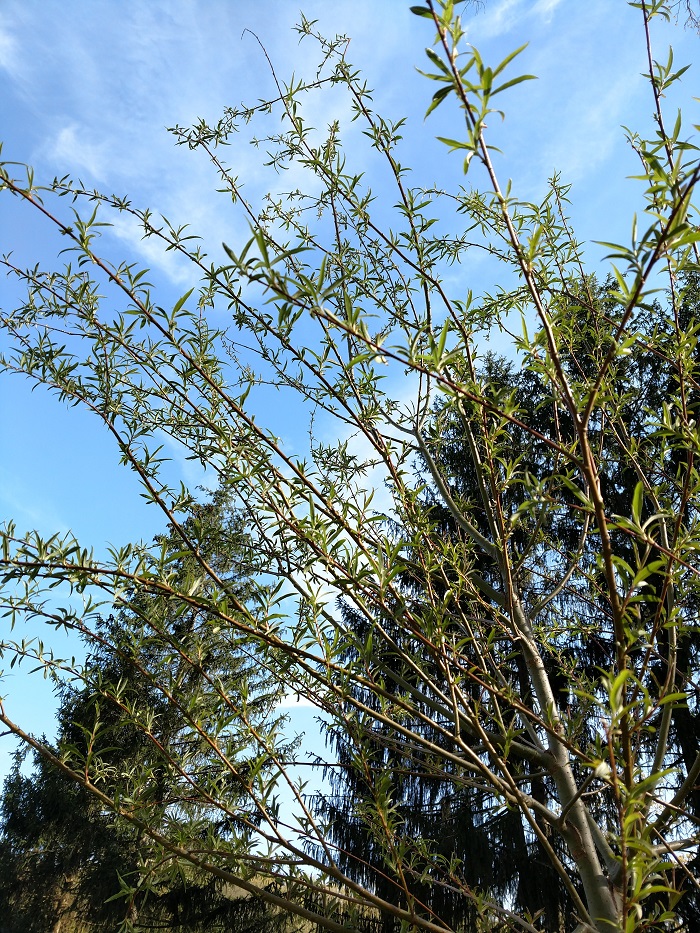
Sneak preview. This is my tree.

Decades ago in an earlier world, we played under a giant weeping willow at my Aunt Greta and Uncle Fred’s house. The wands swept the grass with their finger-tips. We parted them with eager little hands and slipped into a green pavilion, peopled and furnished by make-believe.

I looked at this present-day willow, nearly ten feet tall, its roots bound in a plastic bucket and its fingers reaching into the blue, and I fell in love.

It didn’t fit in my car. At all.

Leaving my love to the guardianship of a red SOLD tag, I raced home to purloin my neighbor’s truck and his good offices as a tree escort service.

Back again, 10 minutes before closing time, my neighbor and the tree-selling staff person lifted the willow into the back of the pickup and secured it with twine and Boy Scout rope-tying knowledge.

Then we drove home.

Did you know that willow roots can grow up to 100 feet from the base of the tree?

And that they are notorious for entangling and crushing sewer lines?

Not a consummation devoutly to be hoped.

As it turns out, the sewer line runs through the backyard, and the willow, like the dogwood, could not be planted in the spot originally chosen for it.

Evidence of the sewer line’s course across the yard

Taking my daughter, a tape measure, and impervious boots, I paced out 100 feet from the sewer line, bringing myself full circle, into the muddy patch I once considered in my dream of reforestation.

And because it’s such a muddy patch, the earth is soft enough for a distracted writer of children’s books with a good shovel, a sunhat, and some pants she doesn’t care about to dig that hole herself.

So I did.

I wrestled with the earth and muddy gloves and slippery boots. I followed directions and dug a hole twice the width of the potted willow’s footprint.

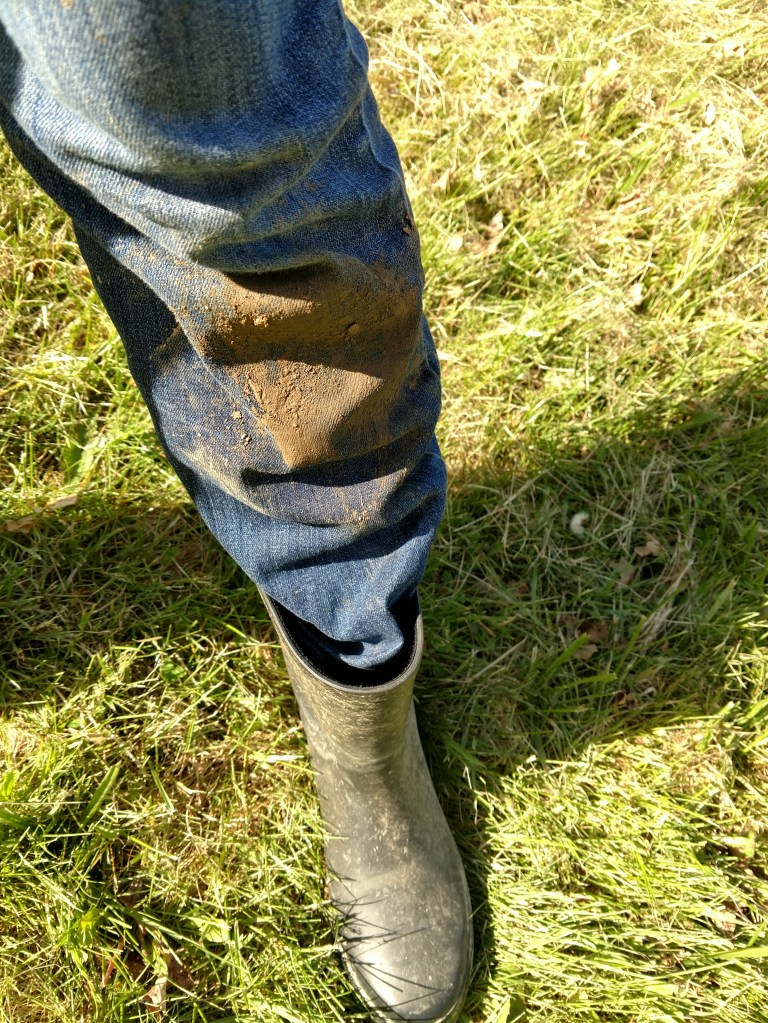
Muddy Blue Jeans taking a selfie with best friend Dirty Boot.

My husband and I hauled the willow across the long yard to the hole and between us, we coaxed it to relinquish its imprisonment. We set its feet in the wet earth, tucked in the roots, and I said a small prayer for it and kissed the tip of a graceful branch.

I dragged out the hose. It’s actually several hoses connected. It’s long, but the yard is longer.

As I was trekking across the space between the end of the hose and the roots of my tree, carrying pitchers of water, I remembered that quiet moment when I’d thought of planting trees here. I saw myself unknowing, pressing along through one decision after another with no recollection or foresight, finding the end of the string where I might have wished to find it, the dream accomplished despite the scattered pathways that led to this good end.

Home, planted, and reaching for the light.

Board Book Story of Saint Eleazar of Anzersk

I’m so happy to announce that Saint Eleazar Fills His Cups is now available for pre-order! Illustrated by my wonderful friend and board-book partner Kristina Tartara, this is the second in what’s becoming a series of saint stories for the littlest believers. Saint Ia Rides a Leaf was our first. We’re excited that these books are finding a home at SVS Press!

Saint Eleazar was a monk who lived in 17th-century Russia. He began monastic life at Solovetsky Monastery, where he was tonsured by igumen Saint Irenarchus. Saint Eleazar was a gifted wood carver, and you can still see his work in the monastery church today.

Solovetsky Monastery stands on its namesake island, which is part of the Solovki archipelago in the White Sea, in northern Russia. But after a time, Saint Eleazar asked the igumen’s blessing to travel to nearby Anzersk Island, to live alone and pray. The igumen granted his blessing, and Eleazar set off.

Anzersk Island in the 17th century was uninhabited, covered in forest, and surrounded by water. There were no towns with shops and no farms to provide food for Eleazar. How would he feed himself? How could he stay alive alone on the island?

Saint Eleazar Fills His Cups is the simple and lovely story of how the saint answered that question. It’s a story about praying to God and using your gifts. In a way, it’s a story about stewardship, a reminder of the miracles we are sometimes blessed to offer one another.

You will love the illustrations. Once again, Kristina has brought the characters and setting lovingly to life, including some animal friends who might have watched Saint Eleazar as he prayed and worked on Anzersk Island. I never get tired of working with her. I love seeing the life and color and depth of my story grow and blossom as she creates the pictures. In children’s books, the pictures are almost more important than the words.

Saint Eleazar Fills His Cups is available for pre-order from SVSPress HERE. It will release this spring, and thereafter will be available from SVSPress, the Ancient Faith Store, and Amazon.

Orthodox Publishers and Non-Orthodox Books

In the years since I’ve been involved in Orthodox publishing, I’ve seen numerous writers who hoped to publish a book that would reach the non-Orthodox. This isn’t unique to us. Christian publishing in general has this hope, and it is not entirely unfounded. But the vast majority of people who read Christian books of any kind are already Christian, or well on their way to becoming so.

This is not to say that when you write for an Orthodox audience, you should be inward looking and lean heavily on references and thought lines only your fellow Orthodox would understand. Clarity and kindness are always essential.

It is to say that if you want to write a book that is not intended for an Orthodox audience, you need to think seriously about why you are sending it to an Orthodox publisher.

Let me say that again.

You need to think seriously about why you are sending it to an Orthodox publisher.

Orthodox publishers have Orthodox customers. Their distribution network and marketing apparatus are designed to convey Orthodox content to Orthodox people, or to those strongly interested in Orthodoxy.

People who are not Orthodox and not currently interested in becoming Orthodox do not buy books from Orthodox publishers.

But there are other, larger flaws in the belief that covertly Orthodox and overtly noncommittal books are good publishing, or good evangelism. I’m reminded of that interesting period when many mainline churches in the USA instituted “contemporary worship” to attract young people and newcomers. In parishes, and in publishing, this amounts to bait and switch.

The religion itself is unchanged. Whatever you felt should be hidden or glossed over to make it more palatable to the uninitiated has not gone away. You’ve simply moved it further down the line, and when it reappears, you’ll face uncomfortable questions about why you felt the need to hide it.

Sincerity is a moral imperative, but it’s also a best practice when creating faith-based media. With that in mind, let’s drill down to four basic questions to ask yourself when considering an Orthodox publisher for your book.

  1. What is this publisher’s target audience?
  2. What is my target audience?
  3. What about me as an author makes me appealing to this publisher?
  4. What makes this publisher appealing to me as a writer?

The Publisher’s Target Audience

In the age of niche marketing and boundless content propagation, publishers excel when they serve a well-defined market. (This is true for other types of business as well.) They may publish books on a variety of topics, but you’ll be able to see common threads, a worldview or mindset, a branded look, that indicates who they expect will purchase and value their books.

Orthodox publishers publish Orthodox books. Some will be straight theology, some will be applied, and some will be fiction. But all will assume an Orthodox worldview, or at least awareness of that worldview, in the reader.

It’s absolutely possible for a publisher to reach readers outside the target audience. But this is more by the workings of providence than anything else. I remember reading once that the only way to expand beyond your niche market is to fill it first. A cup overflows when the water has filled every available space inside.

There are several ways to determine the audience a publisher hopes to reach. The simplest is to look at their website or catalog. What kind of books are there? Who are the authors? What do the submission guidelines say? What books seem to be getting the most attention and space on their website?

Think about the book you have in mind. Can you imagine it on their website? Would it fit in with the other books there? Would the publisher agree that it fit in?

All of these questions should be asked for any kind of publishing submission, not just those to an Orthodox publisher. But the answers should clarify whether your book is actually the type they would publish.

Your Target Audience

As you consider the publisher’s target audience, you’ll also be thinking of your own target audience. When you wrote your book, who were you talking to? Who will enjoy your book or benefit from it? Who buys books that are similar to yours?

Side note: If you believe there are no books similar to yours, ask yourself why that is. It’s a complex question. Does your book meet an unmet need? Or, does nobody publish books like this because nobody wants them?

The more specific you can be, in your own mind, about your target audience, the better. Again – you have to fill a niche before you can reach beyond it. Your writing will be stronger, more insightful and directed, if you know exactly who wants to read it.

Second side note: Remember, a target audience comprises people who want to read your book. You may think they need to read it, but yours is not the opinion that counts.

Once you’ve identified your target readers, compare them to your chosen publisher’s target audience. Are you trying to reach the same people?

If you are trying to reach Orthodox readers, an Orthodox publisher is the way to go. Orthodoxy is itself a niche in the Christian world, especially in the United States. Religious publishing is segregated by faith group, and most religious publishers are unlikely to publish materials espousing a different faith or denomination, both for marketing and for missional reasons.

If you are trying to reach non-Orthodox readers, your target audience probably doesn’t align well with an Orthodox publisher’s target audience. If your work is evangelical, you might find you’d be preaching to the choir. If the people you want to reach are truly “outside the dome,” there’s a good chance they’re also outside an Orthodox publisher’s community of readers and customers.

Appealing to the Publisher

When a publisher acquires your book, they’re also acquiring a professional relationship with you as the author. Don’t forget that you and your credentials are reviewed in any acquisitions decision.

It’s common for Orthodox publishers to publish Orthodox writers, but it’s important to understand the ways that Orthodoxy is and is not a credential for publication. The quality of your writing is the first criteria for publication. You won’t be published simply because you are Orthodox and other Orthodox people aren’t writing on this topic.

However, if you are a good writer and you’re writing on a topic that hasn’t been covered by other Orthodox writers, that’s a selling point. Maybe there are thousands of books on improving your marriage, but if there are only a few Orthodox books on improving your marriage, you have something unique and valuable to offer.

That said, if you are trying to write a book that would be unique in the Orthodox world, remember that it may not be unique in the larger world of Christian or secular publishing. An Orthodox worldview isn’t usually a valued credential “outside the dome.” The very thing that makes you a good prospect in Orthodox publishing may be a handicap with other publishers.

Appealing to the Writer

As an Orthodox writer, it’s tempting to submit everything you write to an Orthodox publisher. Perhaps you’ve published other books with them, or you know someone one staff. It feels like home, like a safe place. That’s understandable.

There’s also a temptation to feel that you’re more likely to be published by an Orthodox publisher than by a “real” publisher. Let that thought go.

Orthodox publishers ARE “real” publishers. They’re not operating from a place of desperation, whatever may have been true in the past. Every year, they receive more submissions than they can publish. Readership and sales are expanding. Many of the books published 20 years ago wouldn’t make the cut now, or would undergo a lot more editing before they did!

It is what it is

These questions and answers all add up to the same thing: Orthodox publishers seek to publish excellent Orthodox books. If that’s what you have to offer, your chances are good. If your book is excellent, but not really Orthodox, it’s time for some soul searching.

Not every book has to be Orthodox, or even about faith at all. As an Orthodox writer, your faith will always be part of your lens, part of your consciousness. But how much it shows in the finished product depends on many factors.

The important thing is to be true to your purpose. Pick a side. Take a stand. If you want to reach people for Christ, don’t hide Him.


Unhappy Holidays

For what it’s worth:

HOLIDAYS ARE HARD.

We soak up a lifetime of unconscious hopes and assumptions about love, family, success, happiness – and those assumptions crash headlong into reality in moments when we expect to be celebrating.

You are a real person, and if you are reading this, you are not in heaven yet. Neither are the people you know and love, or the people you are related to and can’t stand. Neither are the people posting pictures of the life you wish you had.

Earth is the struggle place. If you are struggling, good job! That’s what we’re here for. You are not a loveless ugly failure. You are a human being, created in the image of God, doing the work He is granting you on your journey to grace and joy.

On earth, we catch glimpses. Minutes, or even seconds of light and relief.

Keep your eyes open for the brightness that finds its way through the cracks around you. Rest in that love for the moments when you can see it. Then pick up your tools and get back to work.

No matter what they tell you, no matter what they show you, the people around you are also struggling and waiting.

Against Followership

In a world driven by clicks and likes, I’ve come to deplore followership. The internet, on and off social media, is a fantastic resource. It’s the biggest library the human mind can conceive, conveying ideas in written, spoken, and visual media. But it’s also a constant temptation to comparison and imitation.

How often do you watch a video and decide you need to think like the speaker thinks? How often do you flip through an Instagrammer’s homeschool photos and decide you need to educate your child with the same plans and materials? Yes, these things can be resources, but they can also be an excuse to cede your agency and intelligence to someone more popular, convincing, or attractive than you feel yourself to be.

They call them “influencers” for a reason.

The longer I live, the more I see that people are just people. Even attractive, convincing people are just people. I respect actual credentials. If you have an accredited degree in your field, I’m much more likely to accept the information you are sharing.

But if your credential is the number of YouTube followers you have, I’m frankly not interested. You are a human, and I am a human. Probably, we’re both adults. Like my opinion, your opinion is just that – an opinion. It may be your best effort at putting together the disparate threads of your experience, and I can honor that. But I don’t need to bow to it.

There is only one Person we should be following, and that is Christ.

Little Lost Nun: Video Interview

This conversation was such a joy! Watch me visit with Katie Reetzke from Park End Books, unpacking the stories within and around the story that became Little Lost Nun.

We touched on so many big ideas – the definition of real tragedy, the importance of representation in books for Orthodox children who don’t live in a majority Orthodox culture, the spirituality of children – so many things! I especially loved hearing about the little girl who keep’s her home-made nun paper doll under her pillow. All the ways that children cherish their imaginative memories and bring them into life are precious.

I hope you’ll enjoy watching this interview as much as we enjoyed making it. You can find a copy of Little Lost Nun wherever books are sold.

What we want from Orthodox children’s books

Almost always, an adult is the starting point for a child’s exposure to a book. We choose the books, we purchase the books, we pack our offspring into the minivan and herd them into the children’s section of the library. They can’t obtain books without our help, so we play a large role in their encounters with literature.

That being so, it’s interesting to reflect on the assumptions and wishes that prompt an Orthodox grownup to reach for a particular book. What do we expect from “Orthodox kidlit”? There are many specific answers to that question, but here are three underlying ideas that I suspect are present when a book is invited into your child’s world.

It’s trustworthy.

If a book purports to be Orthodox, it must meet certain standards. You would be stunned to discover it was championing heresy, of course. But there are other, more subtle expectations. You expect it to support your child’s faithfulness, to offer good theology in simple terms, to help you out as a parent. Sometimes we offer a book to our children because we hope it will do a better job explaining than we could, or will at least make a change from our own voice constantly telling them how to be good. We expect the author to be “on our side,” sharing our motivation to pass on the faith to the next generation. If you’re writing Orthodox kid lit at all, you must be a member of the team that walks each child from the baptismal font to a fruitful Christian life when they reach maturity.

IT’S ENGAGING.

To be honest, parents are constantly being let down by books. Sometimes this happens because parents and children are human beings, and what they find appealing and compelling differs. Your child might not see what you see or hear what you hear in the story. But sometimes a book lets you down by failing to present concepts or adapt packaging to meet the needs of the target age. A child’s heart can’t be engaged if you’ve failed to accommodate her developing brain.

I’ve also learned, in recent years, that we adults can frustrate children by overexplaining. They quickly perceive that we don’t see them as capable of perception and discovery. The old advice to writers, “Show, don’t tell” could be a motto for adults interacting with children. I’m thankful for a recent conversation with my friend Sarah, who spoke eloquently about the importance of approaching a child as a full human, a whole person. Drawing on this wisdom, I believe a good book brings the child into experience directly, sparing them the tiresome process of being prompted to enjoy second-hand knowledge of someone else’s transformative delight.

It’s well done.

By this I mean something other than the quality of the book’s content. Like many new things, Orthodox children’s literature as a genre began life looking a bit “home-made” and frankly unprofessional in some instances. When you begin to do something no one has done before, your early attempts will be amateur and faulty. It’s the nature of new things, and it’s an honorable kind of failure, in my view. You have to start somewhere, and you have to make all the mistakes to propel the endeavor to higher levels of achievement.

But I’d posit that the exemption for new effort has expired for this genre. Our readers and their parents have the right to expect expect high-quality illustrations, well-crafted and well-edited text, good paper, durable covers, and the like. Children learn something from every facet of their daily life, and they will notice if the “church” books always look a little shabby next to the secular books.

KEep trying harder!

With no degree programs and only the beginnings of professional development or support for creators of Orthodox children’s books, it may seem presumptive to demand excellence in this field. But still – we should demand it. Any creative process thrives on concentration and persistence. We should be willing to push ourselves, to ask hard questions of our work and welcome honest answers. There’s a temptation to settle for second best, assuming that because there aren’t many Orthodox children’s books, it’s acceptable to put out work that is “at least better than nothing.” We may unconsciously expect that with smaller publishers and a market defined by our faith group, we don’t have to meet the same high standards that would be applied if we were submitting work to Random House or Harper One.

I reject that mindset.

Orthodox publishers in the United States are growing and changing. Higher standards and the ability to be selective are the natural consequence for companies that are thriving. This is an opportunity for sacrifice, or almsgiving. We can give our first fruits to the Lord, a gift that reflects the best of our ability, a gift that is, to the extent possible to a human maker, without blemish.