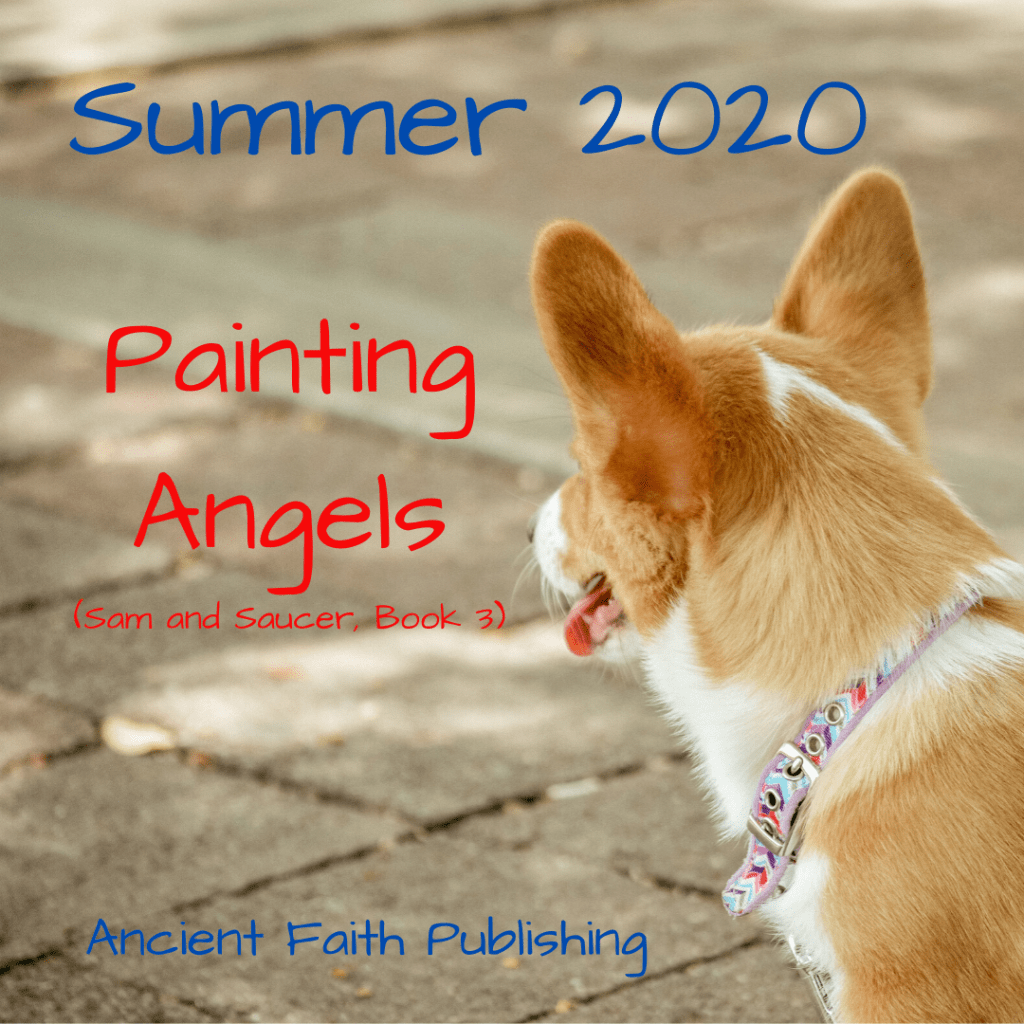
Painting Angels: Coming this summer!

Today, I enjoyed being a writer for a few minutes during a day of otherwise un-writerly work. The publisher sent back the copyedited version of Painting Angels (Book 3 in the Sam and Saucer series). The book is going to press in just a few weeks. I’ve seen some illustrations and sent back feedback, and I’ve worked on all the text edits sent to me. Now I just need to read this copy-edited manuscript, and it will be off to the proofreader – almost finished!

Today I also received the “promo copy” for the book. This is the description that shows up in the publisher’s catalog, on their website, on Amazon, and everywhere the book is sold (in English). When the original manuscript was submitted, I completed an author questionnaire as I do each time one of my books is published. The questionnaire asked me to provide text that could be used to create this promo copy. The editor worked with it, and I’m happy with the final result. Here it is!

What happens when you can’t get away from the person who drives you craziest? Sam and Macrina are about to find out. Stuck working together to help the nuns, Sam and Macrina come up with a thousand reasons to disagree. Sam is too rude. Macrina is too bossy. Summer at the monastery will be miserable if they can’t find some common ground. With the help of three friendly nuns, a runaway bunny, and Saucer the trusty corgi, Macrina and Sam discover a big secret that helps put them on the road toward peace.

Reading this, I realized how well this book fits the time in which it will be released. God willing, we’ll be out and about before the summer, but who knows? Even if we are, our memories of being cooped up, struggling together, will be fresh! COVID-19 never entered my head during the writing process (in fact, the last major revision was completed before quarantine), but today I see major parallels!

Writing and imagination, minds and thoughts, and the whole spiritual atmosphere swirling around us fascinate me. There is no knowing the complex of our connections with each other, or with the unseen influences around us and within us. Perhaps the only key to the mystery is this:

And we know that all things work together for good to those who love God, to those who are the called according to His purpose.

Romans 8:28

God help us all, according to His purpose.

Writing in Faith, not about Faith

I think I just found THE words for an idea I’ve been striving to express for decades. The idea sprouted before I was Orthodox, but here it is in my present context.

Good Orthodox fiction is written IN Orthodoxy, not ABOUT Orthodoxy.

Fiction written ABOUT Orthodoxy (or Christianity in general) will crumple under the weight. Fiction does not do the work of nonfiction; it does a wholly different work, though it can bear similar fruit.

Fiction written IN Orthodoxy is fiction. Fiction may be full of light or full of darkness. The light’s the thing.

Narrative can only act for apologetics, in my view, the way a tune can remind you of a lyric. Faith-informed fiction is the melody only. If it’s rendered accurately, you will know the words.

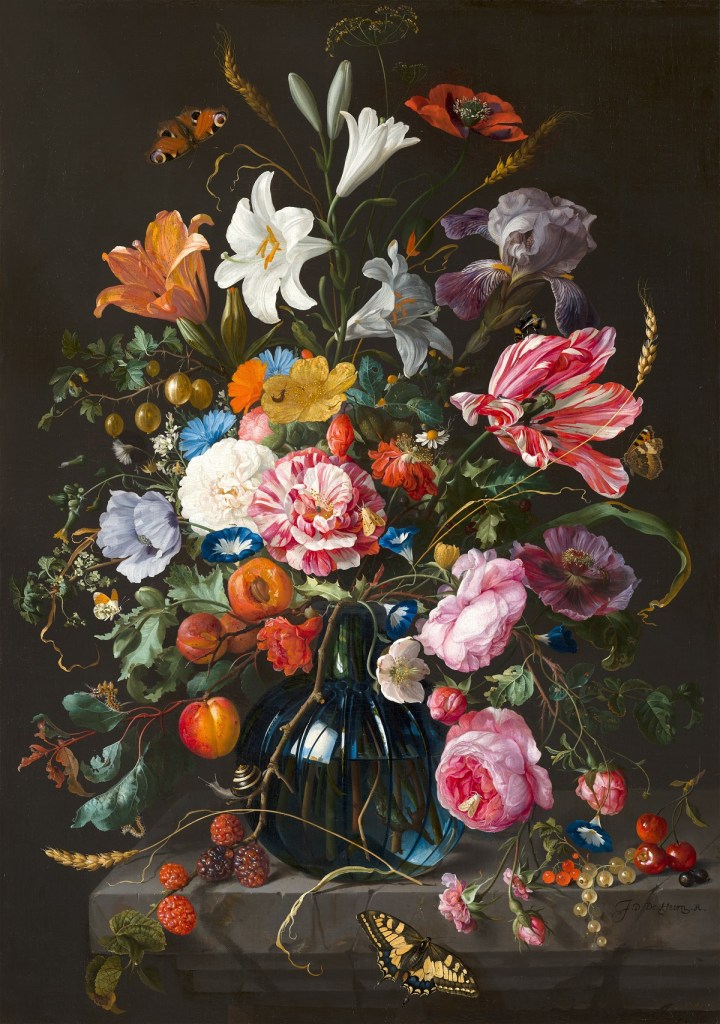
It’s the difference between an oil painting of a flower and the shredded description of the flower pasted to the canvas in a floral shape. Let the explanation be the explanation. Let the portrait be the portrait.

Vase of Flowers. Creator: Jan Davidsz de Heem. Date: 1670. Institution: Mauritshuis. Provider: Digitale Collectie. Providing Country: Netherlands. PD for Public Domain Mark

#Blogtown: Letters from the Homefront

Dear Friends,

Why does this blog post begin like a letter? I’ll tell you.

My friend Anna at The Brown Dress Project is drawing on a lifetime of history-reading for strength and motivation in the present time. I love her assessment of what qualities are needed.

 Thrift, ingenuity, service, hard work, gratitude for daily bread, commitment to neighborliness were all traits which brought families through. Those times are no longer the faded memories of grandparents – they are upon us now.

Anna the Librarian/Historian

In today’s open letter on her blog, Anna’s suggesting that our #blogtown community stick together through this hard time by writing letters to each other. Noting that the front lines for this “world war” run squarely through the home of each person, Anna hearkens back to the days when the efforts of those at home provided the strength and resources for those far away on the more obvious battlefields. That’s why she’s calling for Letters from the Homefront.

If you have a blog, welcome! You’re automatically a neighbor in the #blogtown community. Your well-being matters. The funny moments, frantic boredom, quiet inspiration, fabulous nap, or dogged determination that got you through the day are worth sharing with all of us, your virtual neighbors.

It’s a quiet day at my house. I’m pondering the mix of worry and relief this situation has brought to us. I meant to bake bread today, but instead I played games with my kiddo and took a gray-day walk, looking for leaf buds and early flowers. I even curled up on the couch with the dog and stared out the window at the intricacy of tree branches.

This week has been fiercely busy. I work for an internet company, so working at home isn’t a change. But the sudden influx of EVERYONE ON THE PLANET onto the internet, all hoping to help, all live-streaming, all sharing tips, all asking if this or that is going to happen and when, seemed to make all my days twice as crowded.

I love the surge of helpfulness, but I also believe that we humans aren’t capable of sustaining this level of intensity. Once the novelty of this situation wears off, we will either turn on each other or relax into this new way of being and go back to binge-watching Netflix or reading real, tangible, papery-scented printed books. We’ll walk around the block, and around again. We’ll bake things. Our supply chain will recover from our panic, and there won’t be as much to say about toilet paper any more. But I don’t think normal life will come back for a few months.

I’m at peace for now. Mostly. And exchanging letters with all of you here in this cozy internet community will be something I continue to enjoy.

God bless and keep you,

Melinda

#LettersfromtheHomefront

#BlogtownTuesday: Interview with Cynthia June Long

Today’s #BlogtownTuesday guest is one of the original members of this virtual neighborhood. Cynthia participated in #bloginstead, and we’ve known each other online for years now. I’ve always been fascinated by her “Faerie Librarian” designator, so this interview ought to be interesting! As always, I’m asking 5 questions. Here are Cynthia’s answers.

How did Your blog gets its name?

There’s already a different “Cynthia Long” who writes for the National Education Association; and at least one other creative writing/poet/songwriting Cynthia Long and/or Cynthia J. Long. So I use my middle name to distinguish myself from those others.

My tagline is more descriptive: Faith, Myth, Folklore, Literature | Faerie Librarian. By profession, in my “day job,” I’m a librarian. For fun I read widely in folklore, the fantasy genre, and contemporary literature about faeries. That makes me the Faerie Librarian.

What would you say is the defining characteristic of your blog?

The intersections between faith, myth & folklore. Christian references in folklore. My two favorite examples are “Priest Communes Good Werewolves” from the 12th Century and “The Priest’s Supper,” a~18th or 19th Century Irish tale in which a parishioner relates to his priest a question from the fairies: Will the faeries receive eternal salvation? I shared “The Priest’s Supper” in my presentation at Doxacon 2017; you can listen to it here, starting around minute 11-12:12.

Faerie folklore is my specialty, but I’ve branched out on my blog to occasionally include book reviews of non-faerie books and I sometimes also discuss other literary or personal topics. As a former children’s librarian, I also review select children’s books.

What is your favorite thing about blogging? Least Favorite?

Favorite: Faith-and-Folklore is a niche topic, but it’s my niche. I love it. I could talk (or write) about it all day.

Least favorite: the time required to produce high-quality blog content, and continuing to do so, preferably on a regular schedule, which I haven’t quite been able to manage. Yes, I’m a perfectionist, but let’s face it: good writing requires re-writing. Editing. Formatting. I’ve been disappointed in the posts I’ve thrown up in a rush. Even when offering an opinion, I want to present my best work. And then I’ll go find engaging photos to accompany it. My quest for “the best” accompanying image can sometimes get carried away.

You’re a member of #Blogtown, a social blogging collaborative. How is blogging social for you?

We know the old koan: If a tree falls in a forest, does it make a sound? Is a writer a writer without a reader?

In college, my best friends were the folks who stayed up late debating philosophy and discussing the meaning of the universe. A blog re-creates in written format all those late-night obscure, esoteric conversations. (The best kind of conversations, I might add!) The increased deliberate interactivity of #Blogtown turns a blog post from a soliloquy into a conversation.

Tell us 3 things we’d know about you if we’d grown up together.

  • I have two older sisters; I’m the youngest of three girls. We grew up in “The Brady Bunch” era. Our hair color was lighter as children; I was a blonde or ‘dirty-blonde’ for my first four or five years. (Please don’t call me “Cindy.”)
  • I was a Girl Scout. I loved Girl Scouting. I loved camping. The smell of crisp autumn leaves gets me nostalgic every fall.
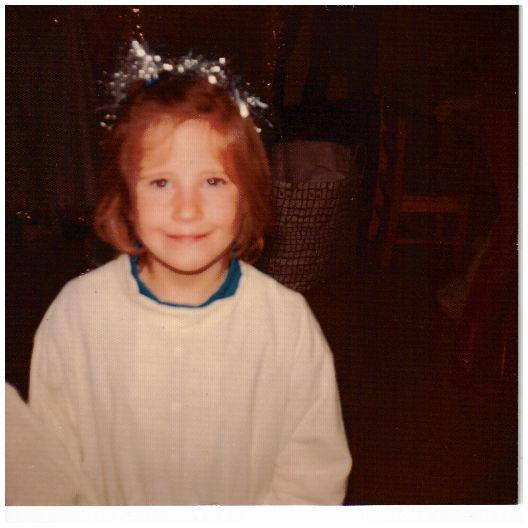
  • As the youngest child, I suffered from not-old-enough-yet syndrome.  The proudest moment of my first 4 years was when I was the Star of Bethlehem in the church Christmas pageant.  I wasn’t old enough to join the heavenly choir of angels like my sisters and the other cool big kids, but for once, I got the better deal. I was the Star of Bethlehem.

Thank you, Cynthia!

You can connect with Cynthia at Cynthia June Long. See you in #Blogtown!

Corgi Seven Leaf: Book Projects Update

This is a happy year in my writing life. I have three books coming out in three genres, from two publishers. I love that!

Corgi

The first book out is actually a third book – it’s the third book in the #SamandSaucer trilogy. The first two, Shepherding Sam and The Barn and the Book, introduced us to Sam, his corgi friend Saucer, and his friends and adventures at the Monastery of St. Gerasim. Sam struggles hard. Sometimes he’s angry, sometimes he’s happy, sometimes he wants to be left. alone. please. Saucer, corgi that he is, loves Sam and follows Sam around and barks at him and pats his foot and even, when occasion demands, takes a good mouthful of Sam’s pant leg and hauls him along where he needs to go.

Corgi standing under a blooming cherry tree
Photo by Alvan Nee on Unsplash

I just handed in my second round of revisions for this third book, and most of what’s left now will be copy-edits and minor adjustments. This book happened in layers, more than the last one did. I originally thought there wasn’t a third book, but with some prodding from my editor, I discovered there was indeed a third book. Like all my books, it fell out of the sky and hit me on the head. This is perhaps not the most dignified writing process, but it works for me! I wrote the story all in one gasp, so to speak, and then set it aside because there was time before the release date. The editor read through her pile and got to my story, and we started in on her first round of big-picture suggestions. The book gained several chapters, the characters gained depth, and it went back to her again for another round. She pointed out a few other adjustments, and that’s what I sent back to her last Sunday night.

I liked working on the characters this time around. They’re two years older than they were in the first book, and I did a little research to help me build out Sam. At no point in the books do we have a name for Sam’s particular kind of struggle. Many people have suggested that he’s on the autism spectrum, and my researched honored that suggestion. However, life has taught me that people with labels and people without labels have more in common than they think. This third book puts Sam together with Macrina, his arch-nemesis. Macrina would be the first to tell you that there is NOTHING the matter with her. But as the story developed, I realized, along with one of their mutual friends, that Macrina and Sam have more in common than either of them would like to admit. Perhaps we all do. For that reason, Sam still does not have a label. Macrina doesn’t either. There’s something in each of their struggles that most of us can relate to.

This book, like the first two in the series, will have a cover and three interior illustrations by the friendly and talented Clare Freeman! And that means I’ve also sent in a detailed list of information for the illustrations – listing scenes I hope will be chosen for pictures, and details of setting, clothing, facial expression, etc, Clare will need to create those pictures.

Seven

Seven Holy Women is a story-telling devotional I’m writing with a group of friends. All told, there are eight of us involved, but our math still works because the book focuses on seven women saints. It’s unique in my experience, for two reasons. First, I’ve never written a book with a group of friends before! Second, I’ve never run across a book like this one. Perhaps one exists somewhere, but it hasn’t popped up yet. Our book is unique because it uses short stories written in the second person to help our readers grapple with their own connections to these saints. “You are Morwenna,” the book begins. YOU. Your brain is wired to read those words and drop your imagination into the story, gazing out at the events as if they were your experiences, in your life. You aren’t Morwenna, of course. You are several centuries too late for that, but when I started writing the four short stories that were the root of this book, I loved the mental and spiritual exercise of trying to stand in these holy shoes, for a few moments only.

I needed help to make this book all that it should be, and that’s where my friends come in. Each of them took one of the seven saints, befriended her, and wrote about her. Each section includes personal surveys and a journaling opportunity, and as of this month, all seven sections are in the manuscript. The only remaining task is for me to write the final chapter, and that’s what I’m pondering now. I’ll wander back through the sections written by my friends and then I’ll have to make up my mind just what that final chapter needs to contribute to finish the book neatly and completely.

Leaf

St. Ia Rides a Leaf, the board book just contracted with SVS Press, is now in the storyboard stage! Kristina Tartara, the illustrator, has sent me the first illustration of Ia, and we’re talking over the color of her dress. This is a story set by the Irish Sea, so nearly every illustration will include shades of blue and green. Ia is a red-head, good Irish girl that she is, and we’ve tried four dress colors, drawn from our research on the dyes available to her in her place and time, and social class. Ia was a princess, so her clothes would be more colorful than those of neighboring peasants.

Meanwhile, Kristina has the final text, and this week she’s breaking it into pages and sketching the rough outlines of the scenes that will appear on each one.

I truly love watching the illustration process. I’d enjoy it for anyone’s book, and to watch my own story appear in pictures is one of my favorite parts of the writing life. It will never grow old! It’s especially delightful when I get to work so closely with the illustrator. Kristina communicates with me often and kindly sends me sketches and snatches at every stage. It makes me happy.

BLOG

And of course, my other writing project is this blog! I am so glad I came back to blogging. I’m finding all kinds of interesting people here in the blogosphere. I enjoy your words and pictures, and the ways they stretch my mind. Thank you for being here!

#Blogtown Tuesday: Interview with The Live Script

Today’s #BlogtownTuesday guest was a toss up – she’s a maker and a blogger, so should she be on #MakersMonday or #BlogtownTuesday?? I asked her. She thought about it, and she picked #BlogtownTuesday. But that doesn’t mean you shouldn’t check out her handmade soap. It smells so good I’m always tempted to take a bite. However, rather than eating soap, I’m asking Sarah at The Live Script my 5 questions, and these are her beautiful answers.

How did your blog get its name?

The Live Script name comes from my sense of being every moment within a narrative taller and wider and deeper than what meets the eye.  Script means not only handwriting, but also a crafted story, and adding “live” speaks to the experience, the immediacy of being present within the story and observing it closely.

What would you say is the defining characteristic of your blog?

This question is quite hard for me to answer.  I know that when I write I am sort of “waving over” the one that comes to read, saying, by my words, “Here, look at this with me.  Experience this scene, this thought; do you see what I see?”  Topically I range from poetry to theology to parenting to cooking, and many stops in between.

What’s your favorite thing about blogging? Least favorite?

I greatly appreciate having a place to spill some of the thoughts that otherwise bang around my head and heart until they’re assembled and given a home.  Writing is crucial for my own understanding and processing and the blog format allows feedback that writing in my journal does not.  Thus far I haven’t experienced any negative aspects of blogging; I’m not well known so I’m not a target for trolls.  My obscurity has been a gift.

You’re a member of #Blogtown, a Social Blogging Collaborative. How is blogging social for you?

Though it can never replace the intimacy of a face-to-face conversation, there is value in the regular reading  of each other’s work.  Even if it is only our thoughts that reach across the miles, there is still connection and community.

Tell us 3 things we would know about you if we’d grown up with you.

  1. I am happiest in or near water, be it the ocean, a creek, or the river in Montana that runs through my parents’ land.  The sound, the smell, and the refreshing buoyant coolness of it never fails to delight me, and I am always the last one out of the water.  
  2. I would rather be up in a tree, or on a bicycle, or sitting in the woods, than playing organized sports or pursuing success or seeking entertainment (movies, concerts, plays).  My parents didn’t know what to make of me; I was not motivated by money nor achievement, but just wanted to be up in my tree, writing and thinking.  
  3. There was never an art form that I wasn’t interested in trying.  Growing up I loved drawing, painting, sculpting, doing collages, sewing, and photography.  As an adult that has expanded to soap making, candle making, miniature pottery, quilting, watercoloring, jewelry making, weaving, and soon, carving wooden spoons.

Thank you, Sarah!

You can connect with Sarah at The Live Script. See you in #Blogtown!

#bloginstead

Lent for Creatives: 5 Hard Lessons

At Ancient Faith, we believe that the spiritual life and the creative life are woven together. The fact that we are an Orthodox Christian media company is proof of this conviction. We exist to promulgate the Gospel through the work of people who use their creative gifts to affirm and explore the life of faith, in the persistent hope of edifying and encouraging our fellow human beings on their journeys.

During this Lenten season, we are all engaged in spiritual struggle of one kind or another, and it seems a good moment to share what I’ve learned in the last five years about the intersection of creativity, struggle, and media publishing. With this goal, I’ve created a list of five hard lessons we all seem to encounter on our way to producing high-quality books and podcasts. If you have already been published, this list will be familiar. If you are still trying to be published, it may be even more familiar! I pray it will be helpful, no matter which side of that fence you occupy.

don’t be an “idea person.”

Almost nothing will shut you out faster than those fatal words – “I’m an idea person.” Many people describe themselves this way, and in our experience, an “idea person” is one who can come up with an endless list of inspiring suggestions but is not able to follow through on them. An idea is like a flame without a lamp. It burns brightly and then vanishes, unless you provide a wick, some oil, and a vessel to hold the oil. Your idea needs a plan. It needs background research. It needs the ability to make and meet deadlines, foresee and overcome obstacles. You and your idea both need a significant amount of staying power, so that your publisher knows you will put in the effort to bring your idea to life – real life, enduring life, the kind of life that will justify the expenditure of staff time, resources, and just plain stamina required to publish a book or produce a podcast. If you were telling yourself that you could hand your idea to a publisher and staff members would provide the wick, the oil, and the lamp, please stop. No publisher can or will be a replacement for the diligent effort you should have dedicated to your idea before we ever heard of it.

Learn the Difference between FElt Need and Perceived NEed.

These two terms are often used interchangeably, and in many contexts they should be. But for you, the creative person, there is an important difference. Creative people need to create. That recurring urge to say something, write something, make something? That’s real. God made you that way. It’s the life force He gave you to ensure that you’d actually use your gifts, that they wouldn’t languish on the shelf in your mind and never see the light. Your “felt need” to create something is real and important, and it should always find expression in your personal creative life, even in your personal relationships. But to break out of that personal realm and into the world of publishing and media production, you need more than your own felt need. You need to identify and meet the felt needs of other people, preferably large groups of other people.  This is one of those intersections between the spiritual life and the creative life – you must serve more than just yourself.

This is where perception is so important. You need to hone your gift for perceiving the needs of other people and channeling your creative gifts to meet them. You can. Creativity and perception are extremely close to each other on the color spectrum of human gifts, I’ve found. It can take some practice, but people who try will discover after a time that they have a special “eye” for the ways their gifts can bring joy or comfort or edification to their fellow human beings. As a media publisher, we can’t meet every single individual need. We are, regrettably, finite. We have to limit ourselves to projects that will help the largest number of people possible with the limited resources available to us. That’s why we want to hear about projects that meet a perceived need. Help us feed the multitude!

Work the problem; don’t step around it.

There are two kinds of work that people often neglect when they’re in the grip of inspiration. One is market research. The other, for lack of a better term, is plot development.

The human condition being what it is (full of humans, all of whom are experiencing it), it’s not impossible that someone else had the same idea you had. It may be completely new to you, but that doesn’t mean it’s completely new to the human world. Save yourself some agony. Get on the internet and find out. Do you want to write an Orthodox book about butterflies? Do an internet search for “Orthodox book about butterflies,” but don’t stop there. Come up with every way you can think of that someone could possibly describe an Orthodox book about butterflies, and do a search for all of them. Market research has a lot to do with that “perceived need” we were just talking about, but it also requires that you know who else is trying to do what you’re trying to do. Did someone else get there first? Did they do what you want to do, only better?

When you discover that someone else already wrote an Orthodox book about butterflies (or otherwise walked off with your inspiration), you have two choices. Both require mature consideration. You can either abandon your idea, or you can develop it to meet a need that other person has not met. Inspiration can be an emotional roller-coaster. Your first impulse may be to fling your idea out the window and weep, or it may be to dig in your heels and insist that your idea is more unique than it actually is. Let go of both of these impulses. They don’t help you. Take a breath, take a walk, and do some hard thinking about what you can do to develop your idea. Chances are, your idea just needs to become more complex. It needs more depth and specificity. If you meditate on it for a while, you may find that you can add an angle or an application. Maybe your book can be an Orthodox book about butterflies for children, instead of adults, or maybe it can be an Orthodox butterfly coloring book with quotes from the Church Fathers about the afterlife (because butterflies are often seen as a metaphor for the resurrection), or maybe….just keep brainstorming.

And that brings us to the other, extremely important part of this point. Keep brainstorming. Whether you find that your idea is 100% original or not, you still need to develop it to the fullest extent. You need to know it inside and out. You need to find all the holes in it, poke your finger through them, and figure out how to fill them. Work the problem. Don’t gloss over the surface, make it all look pretty, and hope. If you don’t find the holes, your publisher will find them. Save us both the sorrow of collapsing something that would have succeeded if you had finished thinking it through.

Lose the agenda; pursue meaning instead.

If you’ve been in Christian media for more than 15 minutes, you’ve heard about the necessity of creating content that is not “preachy.” This comes up most often in writing for children, but it’s just as important in content for adults, especially fiction. Most people don’t think their writing is “preachy,” but you’d be surprised how often someone in the grip of a strongly held agenda can’t see that it has leaked out all over their writing and buried it.

The problem is not that agenda-driven writing doesn’t sell. It doesn’t, but that’s not really the problem. The problem is that when your agenda is sticking out all over your writing, your reader will quickly decide that your main goal is mind control, and they will put the book down and run screaming into the hills.  The lesson you are hoping to teach might be the best, most important lesson in the world. But your anxiety about convincing the reader will be louder than the lesson. Always. And that means it will fail to get through and will instead become a cycle of frustration – your anxiety will increase, you will try harder, and your target audience will run faster and farther.

What’s the solution? Permit me a quote from an old song: “You gotta have faith.” This is arguably the biggest intersection between your spiritual life and your creative life. If you are practicing what you want to preach, if you are truly immersed in the way of life you hope to share, truth and beauty will seep into your words and reach people in ways that aren’t possible when you try to drive the train yourself. If Orthodoxy is true, then it is true in every aspect of human life. If you observe and communicate with deep faith and understanding, whatever you write will become a “lesson.”

Accept the humility of “not being humble.”

In my experience, almost nothing horrifies an Orthodox writer/podcaster/blogger/artist more than the idea of promoting their work. This is a good sign. The person who can’t wait to plunge into the limelight is often prone to errors in taste and judgment, and will  likely be disappointed in the amount of limelight available in the Orthodox media world. Setting aside “I’m shy” and “creative people are introverts,” the biggest reason for this phenomenon is that the Orthodox faith teaches humility. There’s a Bible verse that describes this situation perfectly: “Therefore, when you do a charitable deed, do not sound a trumpet before you as the hypocrites do in the synagogues and in the streets, that they may have glory from men. Assuredly, I say to you, they have their reward.” (Matthew 6:2) Makes you shudder, doesn’t it? It should.

But there’s another Bible verse that’s far more relevant for those of us working in Orthodox media: “You are the light of the world. A city that is set on a hill cannot be hidden. Nor do they light a lamp and put it under a basket, but on a lampstand, and it gives light to all who are in the house. Let your light so shine before men, that they may see your good works and glorify your Father in heaven.” (Matthew 5:14-16).

Letting your light shine can be just as uncomfortable as parading for glory with a trumpet. It can be more dangerous. It can be humiliating. But if you chose to create Orthodox media instead of secular media, you had a reason. There was something good you set out to do, and if no one ever sees or hears your work, it will have been in vain. Your book won’t help anyone if no one reads it. Your podcast won’t spread any light if no one hears it. Like so many moments in our spiritual journey, I believe this is one that requires a deeper understanding of the problem. The simple answer is “don’t talk about your work because it’s not humble.” The more complex answer is that humility might include willingness to serve in whatever way is asked, even the ways that stretch and try us to the limit.

The good news is that if you choose this work, you will be throwing in your lot with a community of people who love what you love and chose what you chose. All of us who are trying to use our creative gifts for the glory of God can walk together on this journey and lift each other up. You don’t need to do this hard thing by yourself. We can keep each other company, promote each other’s work, and comfort ourselves with the knowledge that if we are “doing it right,” the result will not be an embarrassment to us. If your light is shining, and your good works can be seen, God grant that your readers and listeners will “glorify your Father in heaven.”

#BlogtownTuesday: Interview with Summer Kinard

Today’s #BlogtownTuesday visitor is one of the first members of #Blogtown. She’s one of the group who did #bloginstead with me, and her posts in those 3 blissful days were so good to read. I’m talking about Summer Kinard – blogger, yes, and also author, speaker, and what you might call a cultural bridge for people who are differently abled.

How did your blog get iTs name?

My current blog is just my name, SummerKinard.com. I’ve had other blogs over the years, but this is the best way for me to keep my ideas together online.

What would you say is the defining characteristic of your blog?

I try to always write with a recognition of the presence of the Incarnate God. My writing, whether personal reflections or about silly stuff with my kids, or resources for living the faith with disabilities, always comes from my heart and the knowledge that God is with us.

What’s your favorite thing about blogging? Least favorite?

Blogging gives me an opportunity to share what I have learned in a creative nonfiction format without the burden of monetizing it. I love the opportunity to share insights that I can discuss with people with whom they resonate. I can also tell when an idea is salient by watching how it spreads. That’s a big part of connecting with my readers. The part I don’t like is the pressure to blog often. My kids have high stakes special needs, and I have to put them first. I give myself permission to take a few days or weeks longer than I initially planned to post on the blog when the delay allows me to address my family’s urgent needs.

You are a member of #Blogtown, a social blogging collaborative. How is blogging social for you?

I read the Blogtown posts in my WordPress reader at least a couple of times a week. I enjoy listening to other people tell their beauties and their truths. Sometimes I can only tap “like,” but I try as often as I am able to be online to engage with their thoughts or just let them know they’ve encouraged me. I don’t forego other social media in order to blog, but blogging is my favorite type of online platform. I love stories and always have. I even love the stories of recipes on cooking blogs! To me, the most salient part of socializing is bearing witness to goodness and truth and beauty in the world, which includes exploring the process of discovery. I want to know how you noticed a particular rock in the forest or why sea salt and coffee changed your chocolate cake and your life. I love to see how the love of God grows in every crevice of life! Stories are where it’s at.

Tell us 3 thinGs we would know about you if we’d grown up with you.

It’s almost impossible for me to get lost. I used to be an eloper (though I didn’t realize it), and I would spend hours walking into the woods with my dog and finding my way home as a challenge. My mind absorbs details rapidly, giving me an instant map of places I go. I can pay unbroken attention to one activity for hours on end. I used to build houses for doodle bugs out of sand and sticks so I could train them to navigate the hallways. I love to laugh, and I love wordplay. My family had a custom called “shooting the breeze” where we would entertain each other with wordplay and stories. That laughter was a big part of my training in joy.

Thank you, Summer!

You can connect with Summer at SummerKinard.com. See you in #Blogtown!

Snowflakes and Blackberries

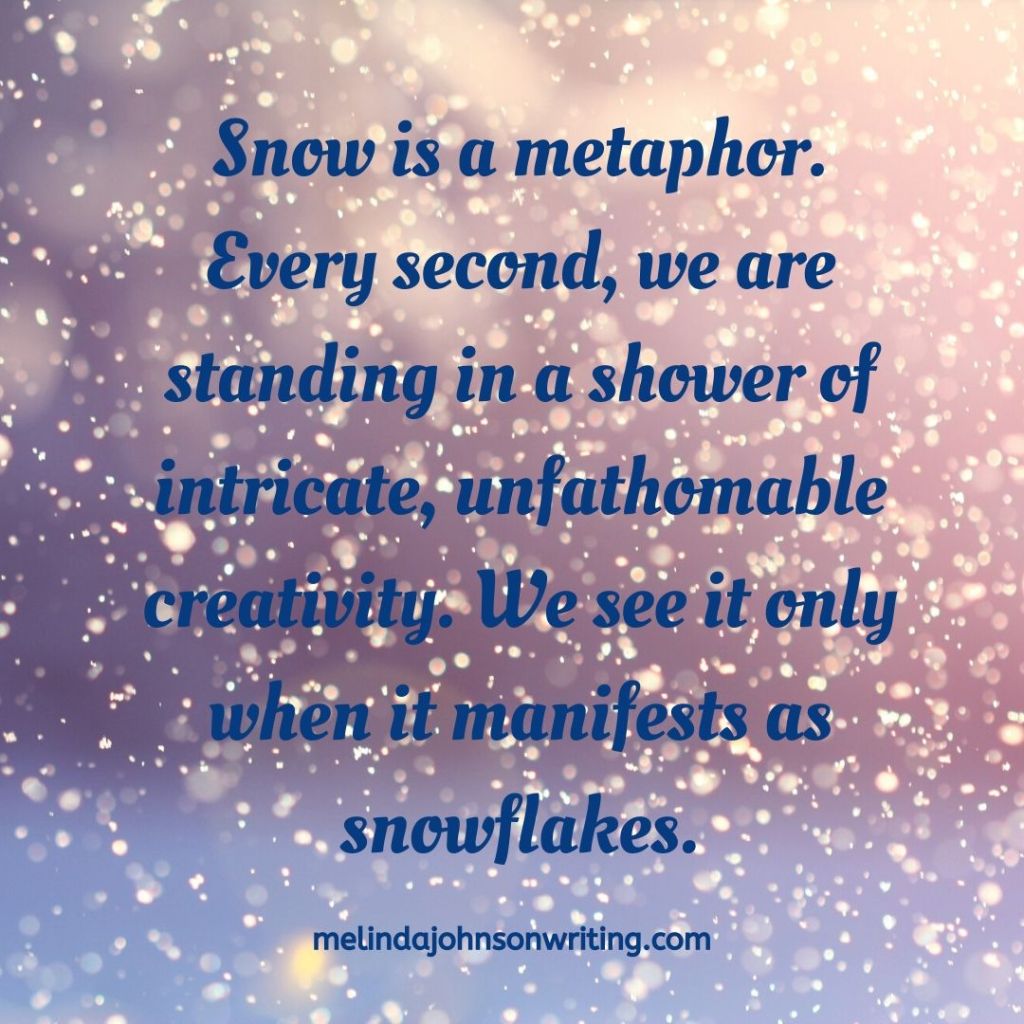
It’s snowing this morning, and coincidentally, I ran across a few words I jotted down about snow, several years ago. It was one of those moments that stretches your mind and reminds you of divinity and cosmos.

This reminded me of Elizabeth Barrett Browning and her words on blackberries.

Earth’s crammed with heaven

And every common bush afire with God;

But only he who sees, takes off his shoes,

The rest sit round it and pluck blackberries…

From Aurora Leigh, by Elizabeth Barrett Browning

Searching for this quote, I rediscovered the longer poem of which it is a part, and found that it articulates my own belief about the spiritual nature of art. I kept reading, and Elizabeth kept building out the thesis in keeping with my own sense of things.

Human beings are inescapably spiritual. We are inescapably natural. We are created in the image of God, incarnated as He was, fully human and whole-souled just as He was fully human and fully divine. As an Orthodox Christian, I believe all creation is lifted up in Christ. ALL CREATION. This means I see God as much in a tiny snowflake as in a book of theology. I love that.

As a writer, I know I can’t let go of spirit to write about natural life. They are not separate. Not in the smallest detail. Some writing is more obviously “spiritual” or “religious” than others, but I believe all good art, perhaps I would say all “genuine” art, has as much spiritual as natural content. The measure of its greatness is the extent to which the fire of heaven shines through it.

Elizabeth says this more beautifully than I could, so here are her words to feed your thoughts on this snowy morning.

From ‘Aurora Leigh’
By Elizabeth Barrett Browning (1806–1861)

TRUTH, so far, in my book;—the truth which draws
Through all things upwards,—that a twofold world
Must go to a perfect cosmos. Natural things
And spiritual,—who separates those two
In art, in morals, or the social drift 5
Tears up the bond of nature and brings death,
Paints futile pictures, writes unreal verse,
Leads vulgar days, deals ignorantly with men,
Is wrong, in short, at all points. We divide
This apple of life, and cut it through the pips,
The perfect round which fitted Venus’ hand
Has perished as utterly as if we ate
Both halves. Without the spiritual, observe,
The natural’s impossible,—no form,
No motion: without sensuous, spiritual
Is inappreciable,—no beauty or power:
And in this twofold sphere the twofold man
(For still the artist is intensely a man)
Holds firmly by the natural, to reach
The spiritual beyond it,—fixes still
The type with mortal vision, to pierce through,
With eyes immortal, to the antetype
Some call the ideal,—better call the real,
And certain to be called so presently
When things shall have their names. Look long enough
On any peasant’s face here, coarse and lined,
You’ll catch Antinous somewhere in that clay,
As perfect featured as he yearns at Rome
From marble pale with beauty; then persist,
And, if your apprehension’s competent,
You’ll find some fairer angel at his back,
As much exceeding him as he the boor,
And pushing him with empyreal disdain
For ever out of sight. Aye, Carrington
Is glad of such a creed: an artist must,
Who paints a tree, a leaf, a common stone
With just his hand, and finds it suddenly
A-piece with and conterminous to his soul.
Why else do these things move him, leaf, or stone?
The bird’s not moved, that pecks at a spring-shoot;
Nor yet the horse, before a quarry, a-graze:
But man, the twofold creature, apprehends
The twofold manner, in and outwardly,
And nothing in the world comes single to him,
A mere itself,—cup, column, or candlestick,
All patterns of what shall be in the Mount;
The whole temporal show related royally,
And built up to eterne significance
Through the open arms of God. ‘There’s nothing great
Nor small’, has said a poet of our day,
Whose voice will ring beyond the curfew of eve
And not be thrown out by the matin’s bell:
And truly, I reiterate, nothing’s small!
No lily-muffled hum of a summer-bee,
But finds some coupling with the spinning stars;
No pebble at your foot, but proves a sphere;
No chaffinch, but implies the cherubim;
And (glancing on my own thin, veinèd wrist),
In such a little tremor of the blood
The whole strong clamour of a vehement soul
Doth utter itself distinct. Earth’s crammed with heaven,
And every common bush afire with God;
But only he who sees, takes off his shoes,
The rest sit round it and pluck blackberries,
And daub their natural faces unaware
More and more from the first similitude.